



BKMT READING GUIDES
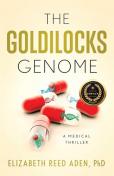

The Goldilocks Genome: A Medical Thriller
by Elizabeth Reed Aden PhD
Paperback : 320 pages
0 club reading this now
0 members have read this book
"The Goldilocks Genome blends grief, science, and revenge into a fast, unsettling medical thriller. . . . sharp, tense, and surprisingly moving.”—Literary Titan, 5-star review
When San Francisco–based FDA epidemiologist Dr. Carrie ...
Introduction
Next Generation Indie Book Award-Winner
"The Goldilocks Genome blends grief, science, and revenge into a fast, unsettling medical thriller. . . . sharp, tense, and surprisingly moving.”—Literary Titan, 5-star review
When San Francisco–based FDA epidemiologist Dr. Carrie Hediger uncovers a rash of unexplained deaths while investigating the suspiciously convenient death of her best friend, she becomes determined to find answers—even if it leads her to a murderer, and even if confronting authority, using her wiles, and bending the rules to get justice risks her future in the FDA.
To unravel the puzzle, Carrie assembles a team: some talented post-doctoral fellows, a quirky pharmacologist, an unctuous chemist, and a skeptical FBI agent that she can’t help her attraction for. Together, they follow the data through the twists and turns, eventually uncovering that the Goldilocks effect in prescription drugs—the premise that people are inclined to seek “just the right amount” of something—is central to understanding these mysterious deaths. Through the twists and turns, Carrie and her team enter a race to uncover the truth . . . and catch a killer.
Grounded in real data analysis techniques, real science and pharmacology, and actual current psychiatric practices, The Goldilocks Genome is simultaneously a taut, race-against-time thriller and a condemnation of the psychiatric industry’s failure to implement genetic-based “personalized medicine”—a problem that persists to this day.
Editorial Review
No Editorial Review Currently AvailableExcerpt
Chapter One: The Unsinkable Wendy WatanabeThere was no choice. It had to be the side facing the Pacific Ocean. Departing cruise ships embarked on adventure. Ships entering the Bay returned passengers to the routine of daily life.
Daily life. That’s what Wendy could no longer tolerate. Living had been a daily adventure until she married the man of her dreams. Jonas was sophisticated, handsome, wealthy, and smart—everything she wanted and deserved. She, herself, was accomplished, just not rich. She’d been a university professor and lived life on her terms. She called the shots—when to get up, what to do, where to go, who to see. Every day, she did what made sense for her. Then she met Jonas. ...
 view entire excerpt...
Discussion Questions
From the Author:The Story
1. What hooked you first — the thriller plot, or the revelation about how prescription drugs actually work? Was there a moment early on where you thought, "Wait, is this real?"
2. Did you find yourself Googling anything while you read? What surprised you most about the science — or about the industry?
3. How did the scientific elements (pharmacogenomics, genetic testing, drug response) enhance—or challenge—your experience as a reader?
4. Did the blending of real science with fiction make the story more compelling or more unsettling?
5. Which scientific concept and which facts in the book surprised you the most?
Main Characters
1. If Jonas had channeled his rage into advocacy instead of murder, do you think anything would have changed? What does the book suggest about whether the system can be changed from the outside?
2. She's an insider — an FDA epidemiologist — using the system to discover and find a mass killer. How did you feel about her as a hero? Did her scientific background or position within the FDA position make her more or less trustworthy to you as a reader?
The Implications
1. Think about the medications you, your parents, or your kids have been prescribed. Has a drug ever inexplicably failed you, or caused unexpected side effects? After reading this book, do you see those experiences differently?
2. If your doctor offered you a pharmacogenomic test tomorrow — one that could tell you which drugs would work for your specific genome — would you take it? What would you be afraid to find out?
3. The book argues that medicine has treated us all as the same patient for decades. Where else in your life have you been on the wrong end of a "one size fits all" approach — in
4. Medical thrillers have a long tradition of using fiction to expose real dangers — think Robin Cook, Michael Crichton. Did this book change anything about how you'll healthcare or anywhere else? Approach your own healthcare? Will you ask your doctor about genetic testing?
5. The author offers a free download Goldilocks Drugs & Genes—One Person’s 10-Step Guide to Personalized Medicine (www.ElizabethReedAden.com). The pamphlet is a which is “how-to” guide to take your 23&Me or Ancestry DNA results and determine whether your genes are “just right”, “too little”, or “too much” for the 80% of prescription drugs. Has your interest been piqued sufficiently to explore your drug:gene interactions?
Responsibility & Credibility
1. Who do you hold most responsible for the problem at the heart of this book: the pharmaceutical companies, the FDA, practicing physicians, or all of the above? Did the novel change your answer?
2. The author spent her career inside the industry she's critiquing. Does that make the book feel like a confession, a warning, or both? Did you trust her more or less because of it?
What If…
1. If you could put this book in the hands of one person — a policymaker, a CEO, a doctor, a patient — who would it be, and what do you hope they'd do differently afterward?
Weblinks
| » |
Publisher's book info
|
| » |
Author's website
|
| » |
Book DNA
|
| » |
The Genome Killer Podcast
|
| » |
Reader's favorite Book Review
|
Notes From the Author to the Bookclub
Q and A with the Author: The book's premise — that prescription drugs work for only about 40% of patients depending on their genetics — is genuinely alarming. How did you first encounter this truth, and when did you realize most people had no idea??I didn't encounter it as a single revelation — I lived it, slowly, over decades. When you work in Pharma and participate in product development, you watch drugs go through clinical trials with knowing the averages conceal enormous variation. You see the 40-60% who don't respond as predicted, often are covered by statistics. What struck me wasn't that the science was hidden — pharmacogenomics has been understood for years — it was that the urgency and the regulations never matched the knowledge. The gap between what we knew and what we were doing about only began to narrow when we were able to sequence tumors and treat patients with precision medicines. Outside of oncology, most patients have no idea that their antidepressant, their blood thinner, their pain medication was tested usually in a European population, often on men between 30-55 years of age, weighing 70-80 kilograms. The population tested in clinical trials rarely reflects the actual patient population—thus giving a drug its best chance of statistical success. Why a thriller? You had the credentials to write a scientific book, a policy paper, a memoir. What made fiction the right vehicle??I heard Irving Weissman, one of the founders of stem cell biology being interviewed on NPR. He was asked, “How does the lay public to learn about science?” “Fiction.” He answered. It made sense to me. I love to read fiction based on fact—my favorite authors, Michael Crichton, Kathy Reich, and Dick Francis are each experts in their field and their books are laced with luscious facts. In the pharma, we know this is an issue and it is taken into consideration for drug development. Policy papers and scientific books are dry and more people read fiction and the lay audience needs to know this information and initiate discussions with their physician and pharmacist. Tell us about Jonas von Gelden. He's the villain — but he's also, in some ways, an honest, well-intentioned character.?Aspects of Jonas’ personality are modeled on someone I know but who would not go to the extremes that Jonas does. I loved that his anger was entirely justified and he had the resources to bring attention to the problem. In some ways like the Tylenol murders or anthrax poisoning did. The system responds to fatalities, like the protective seals on caps were required after people died from Tylenol contaminated with cyanide. He didn't invent the problem. The system failed someone he loved, and the people responsible faced no consequences. What separates him from the rest of us isn't his rage — it's that he acts on it. I think every person who has watched a loved one suffer through the wrong medication, or receive a diagnosis that came too late, understands the impulse even if they'd never follow it. I wanted readers to stay with that discomfort rather than dismiss him as simply a monster. An easy, gratuitous villain let the reader off the hook. Your protagonist works inside the FDA — the agency that's supposed to prevent exactly what happens in this book. Was that irony intentional??Very much so. I wanted her to have the resources to be able to find the killer. Her pharmacologist friend and colleague is the one who introduces her to the importance of personalized medicine. She also has to fight to be heard because she is rocking the institutional boat—this is pretty standard in any company or institution. The title is beautiful and does a lot of work. Can you explain it for readers who haven't picked up the book yet??The Goldilocks genome is the genetic profile where a drug works exactly as intended — not too strong, not too weak, but just right. The fairy tale is the point: for most medications, that "just right" patient is as fictional as Goldilocks herself. We've built an entire pharmaceutical system around a one-size fits all approach and today we have the tools to get the right drug, first time when we match genes, drugs, artificial intelligence, and physician diagnosis. — the average. Everyone understand the Goldilocks fairy tale and it’s meant to intrigue the reader to wonder how the genome fits into the “too little”, “too much”, “just right” story. The reader ultimately realizes that they are Goldilocks and they have been trying different drugs until they get to the one that is “just right” for them by trial and error. Those days should be gone! You spent years as SVP of Global Pharmaceutical Strategy at Roche, and co-founded a biotech company. Did colleagues in the industry push back when the book came out??Absolutely not. Pharma has been championing this approach for decades. The pushback has been elsewhere because we didn’t have the tools and technology to implement personalized medicine in a cost-effective manner. Today, the cost of a complete genome is about $100, we have data storage capacity that can rapidly handle exobytes of data, and the large language models can access prescribing information and match a patient diagnosis to the right drug—all in real time. The science in the book is accurate and detailed. How did you decide how much to include without losing the thriller reader??I wanted the reader to understand why the understanding the science was important. I did a lot of research for the book and I included many of the details I found interesting. I made the assumption that if this was new information to me it might be new and interesting to others. I had the advantage of having worked with these concepts for a long time so I could explain it in plain language. The goal was for a reader with no science background to feel informed, and, hopefully, not lectured to. This book has won the International Impact Award, the American Legacy Book Award, and the Indie Book Award for fiction. What does "impact" mean to you in the context of this story??I want someone to finish this book and do two things: first, get their DNA tested and find out where their genes are on the Goldilocks spectrum (download my free pamphlet Goldilocks Drugs & Genes from my website for the “how to” instructions); and second, ask their doctor about prescribing drugs based on pharmacogenomics. That's it. I want that conversation to happen. If even a fraction of readers become advocates for their own genetic uniqueness — if they stop accepting "the drug didn't work for you" as a shrug and start asking why — then the book has done something real. Fiction that changes behavior, even slightly, is impact—this is the measure I care about. You're also a biomedical anthropologist with fieldwork roots in Melanesia. How does that background — studying human populations in the field — connect to a book about genetics and pharmaceutical failure??More directly than people expect. Fieldwork teaches you that humans are not uniform — that culture, biology, history, and environment produce enormous variation in how people live, who gets sick, and how they respond to intervention. The epidemiology and statistics used in the book were based on analyses I learned doing my dissertation on the natural history of infection with hepatitis B virus (HBV). The natural history of infection was more nuanced that our current approach to how HBV is transmitted to infants. Genomics taught me the same lesson about the importance of detail and nuance at the molecular level. The one-size-fits-all model of medicine and global health was reflective of the averages but the actual story was more interesting. In some ways, The Goldilocks Genome is the book I is an extension of my anthropological fieldwork and findings. What do you want readers to do when they finish the last page??Order their DNA from a reputable provider (wait for a holiday sale). Talk about it. Ask their doctor or pharmacist whether genetic testing might change what they're currently prescribed. And if the doctor doesn't know what pharmacogenomics is — which still happens more than it should — give him a copy of The Goldilocks Genome which is what my friends and I did for our primary care physicians. What's next??My memoir, Mud, Microbes and Medicine, is now available — it traces how those early years of fieldwork in Melanesia shaped everything that came after. I also have a first draft of a non-fiction book on getting to know your genome and what it can tell you (not title as yet). In a slightly different mode, I’m getting the last of my godmother’s out-of-print cozy mysteries published. Eunice Mays Boyd was a wonderful, award winning writer who deserves to be rediscovered.Book Club Recommendations
Recommended to book clubs by 0 of 0 members.
Book Club HQ to over 90,000+ book clubs and ready to welcome yours.
Get free weekly updates on top club picks, book giveaways, author events and more