




BKMT READING GUIDES
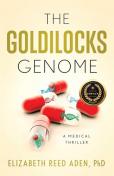

The Goldilocks Genome: A Medical Thriller
by Elizabeth Reed Aden PhD
Paperback : 320 pages
0 club reading this now
0 members have read this book
"The Goldilocks Genome blends grief, science, and revenge into a fast, unsettling medical thriller. . . . sharp, tense, and surprisingly moving.”—Literary Titan, 5-star review
When San Francisco–based FDA epidemiologist Dr. Carrie ...
Introduction
Next Generation Indie Book Award-Winner
"The Goldilocks Genome blends grief, science, and revenge into a fast, unsettling medical thriller. . . . sharp, tense, and surprisingly moving.”—Literary Titan, 5-star review
When San Francisco–based FDA epidemiologist Dr. Carrie Hediger uncovers a rash of unexplained deaths while investigating the suspiciously convenient death of her best friend, she becomes determined to find answers—even if it leads her to a murderer, and even if confronting authority, using her wiles, and bending the rules to get justice risks her future in the FDA.
To unravel the puzzle, Carrie assembles a team: some talented post-doctoral fellows, a quirky pharmacologist, an unctuous chemist, and a skeptical FBI agent that she can’t help her attraction for. Together, they follow the data through the twists and turns, eventually uncovering that the Goldilocks effect in prescription drugs—the premise that people are inclined to seek “just the right amount” of something—is central to understanding these mysterious deaths. Through the twists and turns, Carrie and her team enter a race to uncover the truth . . . and catch a killer.
Grounded in real data analysis techniques, real science and pharmacology, and actual current psychiatric practices, The Goldilocks Genome is simultaneously a taut, race-against-time thriller and a condemnation of the psychiatric industry’s failure to implement genetic-based “personalized medicine”—a problem that persists to this day.
Editorial Review
No Editorial Review Currently AvailableExcerpt
Chapter One: The Unsinkable Wendy Watanabe There was no choice. It had to be the side facing the Pacific Ocean. Departing cruise ships embarked on adventure. Ships entering the Bay returned passengers to the routine of daily life. Daily life. That’s what Wendy could no longer tolerate. Living had been a daily adventure until she married the man of her dreams. Jonas was sophisticated, handsome, wealthy, and smart—everything she wanted and deserved. She, herself, was accomplished, just not rich. She’d been a university professor and lived life on her terms. She called the shots—when to get up, what to do, where to go, who to see. Every day, she did what made sense for her. Then she met Jonas. Jonas cherished her lifestyle until the day they married. That first night, their wedding night, something changed. It wasn’t the sex, which was always good, but something in his attitude. It was as if she had surrendered her freedom to become his domesticated animal. The paramour, who had been so fun and understanding, wanted her to quit work. He insisted she join those well-connected nonprofit organizations that provide socialites with the illusion of purpose. Dinners, dances, and days filled with mindless chatter. She was forbidden to step off her husband’s social treadmill and torn between the cultural conflicts of the traditional and professional female roles of a first-generation Japanese American. Her descent began with a leave of absence from the university. She missed her classes and the satisfaction of teaching the wonders of geology: the ageless story of how minute changes over time can create masterpieces of stunning proportions. Incremental change, over five hundred million years, transformed rotting forests into oil fields as streams of water sculpted sedimentary rock into the Canyonlands. Water. It was her expertise and passion. It was how she’d met Jonas. She remembered when he’d walked into her office seven years ago, asking whether she could find a new source for bottled water. She’d been intrigued by his French accent and continental manners. He’d seemed more than just another good-looking man. She’d agreed to consult for him on his new project. She’d reviewed subsurface maps, geologic sections, historical sources, and, ultimately, the ultrasound that confirmed the presence of an aquifer in a remote part of the Sierra Nevada. He’d tapped it and was pleased with its unique taste. Her lab tests confirmed that gold was one of the mineral impurities. At that moment Au de l’Eau was born. Together, they’d created the name. He’d started describing it in French and she’d seen the potential for a pun from the Periodic Chart. Au de l’Eau grew to become his most profitable and prestigious brand. It had taken his business to the next level and made him even richer. At first, they had been prospecting partners. Their eureka moment happened together. When he secured the water rights from the US Forest Service, he’d asked her to marry him. Incremental change. Like the rocks and processes she studied, she too had changed. Under relentless pressure and emotional heat, she had metamorphosed, bit by bit, over the years, like limestone into marble. Today, Wendy Watanabe von Gelden was someone she neither recognized nor liked. She no longer laughed when Jonas was late or said something insensitive; instead, she got angry. The monotony of her day wasn’t relieved when he arrived home. She didn’t have either the energy or the will to defy him. Subjecting him to angry outbursts didn’t improve their relationship. Sex was no longer satisfying, eating was an effort, and the oblivion of sleep was when she felt best. Major depression. That was the diagnosis, a socialite executive director suggested. It was endemic in their social circle, especially among women. They told her once you took an antidepressant and listened to Prozac’s siren song, life would become good again. She’d gone to the doctor, gotten a prescription, and taken the pill that described itself as a selective serotonin reuptake inhibitor, thankfully abbreviated as SSRI. She’d waited three weeks for it to work its magic and then another three with still no noticeable effect. She felt worse if anything—even less energy and no appetite. She’d talked to her doctor, who said that was often the case and to come back after three months of treatment. He promised if this didn’t work, they’d try other drugs until they got it right, which could take up to a year. Great. Trial and error. Another year was too long to wait. She couldn’t and wouldn’t wait. She decided to end this life and begin a better journey. She did her research. Pills left you unconscious and took too long. There was an opportunity for people to find and save you—statistics showed 4 percent to 12 percent success with pills versus 98 percent for jumpers. No, pills were not reliable. This was it. Bay side or ocean side? This decision was hers and hers alone. Almost everyone jumps from the Bay side. Perhaps it was their oblique statement of wanting to belong and wishing to have been part of the City, or simply because it’s the side open to pedestrians. Not her. She wanted to see the hills and shoreline shaped by the eons-old geological processes she loved. She left her car in Sausalito at the yacht club, a convenient place to park when approaching from the north. She walked through the town’s main street past the bustling tourist shops, followed by a solitary two-hundred-foot climb that would test her resolve. She trudged up the hill while the bicyclists blurred by on the other side of the road. She was headed to the west side where the traffic flows into San Francisco. It’s ironic, she thought, that one has to walk toward the City to get to the Pacific side. She hiked next to the railing and looked over the edge, mesmerized by the beauty and simplicity of it all. She passed the stanchions supporting an elegant, soaring tower painted international orange. Looking down at the tower support, she saw that the water would embrace her, while the concrete would splatter her. It was her choice what her corpse would look like. How interesting, she noted—a ledge ran along the outside of the railing. This is how it should be, with cables to help pull you up and provide stability as you go over the railing, and then a ledge from which to make a graceful exit. At mid-span she saw a small alcove for bridge workers. She nestled herself there and looked down and out. The ocean was a vapid greenish gray, undulating gently with the tide moving out toward the Farallon Islands thirty miles away. She put her purse down, climbed over the rail, and dropped down to the ledge. One bicyclist stopped, then another. A small crowd started to gather. “Hit the suicide alarm!” someone called out. If she turned back now, she would be arrested and dragged off in handcuffs for violating the law, so she continued to look only down. Behind her she heard increased noise and a slur of words. She leaned outward and thought she could see the islands as she let go. For the next four seconds she was completely free. ***** Jonas tilted his head, listening to the comforting hum of water bottling in the background as he scribbled in his planner. The machines were simple but efficient—over twelve thousand bottles were filled every hour, around the clock, each one adding twelve cents to his overflowing bank account. Jonas owned a 55 percent stake in Sierra Santé, which earned him a healthy $26 million a year, not counting his $4-million salary as CEO. Jonas left the loading dock and headed to his car. The day was crisp and clear, and the sun felt good on his shoulders. It was a perfect day to take the scenic Silverado Trail, straddled by vineyards. The road followed the wagon trail built in 1879 to the Silverado mine on Mount Saint Helena. As he drove, he mused how the word “Silverado” was a typical Americanism—an amalgam of an English noun with a Spanish suffix. Jonas remembered Wendy explaining that it was a post–Gold Rush marketing gimmick, meant to conjure up Pizarro’s El Dorado—an image that proved similarly ephemeral. Wendy had also explained how the Napa Valley owed its character to Mount St. Helena, the eruption of which three million years ago had fertilized the river basin. Volcanic debris was the source of the Valley’s economic wealth; it created the rich agricultural soil with glitters of gold, slivers of silver, and abundance of more mundane minerals—magnesite and cinnabar. Water was trapped in a granite-lined gigantic sinkhole where, over the millennia, elements and ions were leached from the rock to create a unique mineral water. Mineral water. Eau minérale. Mineralwasser. No matter which language he used, Jonas loved these words. Mineral water had made him wealthy. Mineral water had given him Wendy. Mineral water had brought him life. Business was good, Jonas thought as he drove. Life was good. ***** As much as Jonas liked being at the factory, it was only at home that he felt truly at peace. Every evening he arrived home at six o’clock precisely, certain that Wendy would greet him on the porch with his usual after-work Dubonnet. He frowned when he drove onto his circular driveway and noticed a lone figure standing on his porch—a lone figure who wasn’t Wendy, and who wasn’t holding a Dubonnet. Then, to his dismay and surprise, he saw his driveway occupied not by Wendy’s black Range Rover, but by a beat-up car bearing the insignia of the St. Helena Police Department. The figure on the porch was a uniformed officer and Jonas, who was occasionally perplexed by human expression, knew instantly he was the bearer of bad news. Jonas pushed the button and waited while the garage door opened, then drove his silver “ultimate driving machine” into the empty cavern and parked. He opened the interior door, slipped off his loafers, and entered the farmhouse he’d bought and renovated until it was a larger, more elegant version of his family’s home in Alsace. He plodded down the hallway on the custom-designed mahogany parquet floor to the front door in his stocking feet, opened the door, and confronted the middle-aged figure in the black polyester uniform facing him. “Mr. Jonas von Gelden?” “Of course. This is my house. Why are you here?” Jonas recoiled away from the man, who reeked of cigarette tobacco. “I’m sorry to bother you,” the policeman said. “I’m Officer Martini with the Saint Helena Police Department.” “Obviously. Why are you here?” Jonas said. “Is Wendy von Gelden your wife?” Officer Martini asked. Jonas nodded, with a pronounced scowl. He didn’t like where this conversation was headed. “Of course she is. What do you want with Wendy?” he asked and then, with a dismissive and annoyed look, reiterated, “Why are you here? Officer Imbécile, get to the point.” “I think we’d better go inside,” Officer Martini said as his hands clenched into fists. He took a deep breath and added, “I have some news for you.” “Any news you have to tell me can be said here.” Jonas placed his hands on his hips, further blocking the doorway. “Tell me now or this conversation is finished, idiot du village.” Officer Martini looked away from Jonas and pulled out a small spiral-bound notepad. He flipped through it and read from a page toward the back of the pad. “We got a call from the Marin Police Department at two o’clock this afternoon,” he said. “We can’t be entirely certain, but there’s a chance that your wife jumped off the Golden Gate Bridge.” “What!” Jonas cried. “That is absurd! You and your police are not only stupid, you are also incompetent. You obviously have the wrong person. What evidence do you have?” “It’s true, no body’s been found,” Officer Martini said. “The strong tides took care of that. But we talked to several eyewitnesses who identified your wife as the jumper.” “How could these anonymous, so-called eyewitnesses know Wendy? Wendy would never betray me. This is insane.” Jonas took a step toward the policeman, who was easily four inches shorter and forty pounds heavier than Jonas. “My wife is one of the happiest people on this planet and has everything to live for,” he insisted, spittle gathering on his lips. “This is another example of police incompetence and mistaken identity. Leave.” Officer Martini frowned but did not move. “The jumper left her purse on the ledge,” Officer Martini said in a calm voice. “It was your wife’s purse. I’ll have the police department send it to you when they’re done with it.” He pulled a flash drive out of his pocket. “Photographs of her purse’s contents are on this flash drive. I’m afraid you’re going to have to accept that your wife jumped off the Bridge. It happens . . . more often than you think.” Officer Martini handed the flash drive to Jonas. “Why would I want this? Wendy will be home soon.” Jonas recoiled and let the flash drive fall on the flagstone paver. “I am sorry,” Officer Martini said. He handed Jonas his card, which Jonas also let drop on the ground. “If you hear anything more, or if she shows up later, please call me right away.” “I won’t be calling you, ever, crétin. You can tell your boss that his overpaid messenger wasted his time. Good night.” Jonas slammed the door on Officer Martini, took out his cell phone, and tapped Wendy’s number on his quick dial. He imagined the two of them drinking wine later that evening, laughing at the thought of Wendy doing something so juvenile as jumping off the Golden Gate Bridge. No answer. He scurried to the kitchen and checked the wall calendar. That was it! Wendy had an afternoon meeting with John Carney, the Director of the Marin Ballet and one of his most trusted friends. Their meeting must have run late. Jonas walked back into the living room, dialing Carney’s number. “John, great to hear your voice,” Jonas said into the phone, talking twice as fast as normal. “Can you tell me what time Wendy left your meeting this afternoon?” Carney paused on the other end. “Strange you should ask,” Carney said. “Wendy missed our meeting. It’s not like her. I was going to call you later. I left a few messages on her voicemail, but she hasn’t gotten back to me yet. I assumed you and she were out on one of your adventures.” “She never arrived?” Jonas asked. “You were unaware?” Carney said. “Strange indeed—it’s not like our darling Wendy to miss a meeting. We so value her contribution . . . and, I should add, your contributions.” “Of course,” Jonas said. “I’m sure she has a good excuse,” Carney said. “One I’ll insist on hearing the next time I see her. Please give Wendy our love and tell her we can reschedule at her convenience.” “Of course,” Jonas said again, hanging up the phone as if in slow motion. He walked back to the foyer, opened the door, and watched Officer Martini’s car drive away. When it was out of sight, he picked up the flash drive and the business card. ***** After a stiff drink of Macallan 18, Jonas went to his library where he was surrounded by impressionist paintings that captured the sights and ambiance of his birthplace and his more recently acquired California Plein-Air collection. He spent the next several hours calling anybody who might know of Wendy’s whereabouts. He called her colleagues, her friends, and even a few remote family members, none of whom Jonas had met. He didn’t specifically say that Wendy was missing, but that he’d taken her ATM card by mistake and wanted to let her know. The hours passed slowly. As the sun made its first appearance through the elm trees in his backyard, Jonas considered how things had become more strained recently between him and Wendy. Even with alcohol, she was more distant and less engaged than she once had been. Their relationship wasn’t terrible . . . it just wasn’t idyllic. Maybe it was time to look at the flash drive. Jonas squinted at the computer screen—with all the modern technology available, it irked him that the photographs of Wendy’s purse were of inferior quality. Everything he assumed that Wendy would carry in her purse was there—a brush, keys, three rolls of mints—Wendy was fanatical about her breath—several receipts and mangled business cards, even a popular science paperback. The only thing that seemed out of place was an amber bottle with a childproof cap. Odd, Jonas thought—he wasn’t aware that Wendy was taking a prescription for anything. He zoomed in on the bottle. The label read: Wendy von Gelden, Fluoxetine HCl 40 mgs. Take twice daily. Dr. Hempstead, Stanley. A quick search on Google revealed that fluoxetine was the generic name of Prozac, an antidepressant used for the treatment of major depressive disorder. But what would Wendy be doing with a bottle of these pills? She wasn’t depressed. What reason could she have to be unhappy? Further research informed Jonas that fluoxetine was not only prescribed for depression, but for bulimia, panic disorder, obsessive-compulsive disorder, and premenstrual dysphoric disorder. The pills obviously weren’t for bulimia, Jonas thought. Wendy ate sparsely, but he had never heard her belch, much less vomit repeatedly into the toilet. Panic disorder? Wendy was reserved but calm—she had never appeared uncomfortable socializing among large groups of people. Obsessive-compulsive disorder was a possibility. As a scientist, Wendy liked a certain amount of order, but then Jonas reflected that she wasn’t compulsive about it. He read again the last item on the list: premenstrual dysphoric disorder. Jonas scratched his head. Despite being several years past the “proper” age, Wendy frequently expressed her desire to have a baby. Jonas sighed with relief—that must be it. But then again, why was a psychiatrist’s name on the label? For the next two hours Jonas puttered around his house, not knowing what to do. He fixed himself a light breakfast that he was unable to eat. He shuffled through some junk mail that had accumulated on the kitchen counter. He read the newspaper. All the while, the thought of that amber bottle never left his head. To indulge his curiosity, he decided to call Hempstead. Jonas and Stan Hempstead had known each other socially for over two decades. Jonas considered him to be in an unnecessary profession—with no scientific method or potential cure. What did he have to do with Wendy? Why was she wasting money with that charlatan? Not only that, the two men rarely saw eye to eye. Their mutual personal dislike for one another was balanced only by their respect for each other’s professional success. To Jonas’s displeasure, it took nearly twenty minutes to get Dr. Hempstead on the phone. “Jonas,” Dr. Hempstead said. “I’ve been meaning to call and personally thank you for your contributions to the Foundation for Bipolar Research.” Jonas ignored the doctor’s obvious attempt at flattery. “Why was my wife taking flu-ox-e-tine?” he asked bluntly, stumbling to pronounce the unfamiliar word. “Fluoxetine,” Dr. Hempstead corrected Jonas’s pronunciation and then paused on the other end—a long, disquieting pause. “I’m sorry, Jonas,” he said. “I can’t discuss your wife’s medical condition with anybody. Not even you.” To his credit, Dr. Hempstead sounded almost genuinely apologetic. “My wife is missing since yesterday,” Jonas hissed. “An idiot messenger from the police department was here yesterday saying she jumped from the Golden Gate Bridge. Now, tell me why Wendy had these pills!” Doctor Hempstead paused for several seconds before answering. “I hope the police are wrong,” Dr. Hempstead said, “but legally my hands are tied. Unless we have a body, I cannot release her medical records, not even to you. As frustrating as this is, I’m sure you understand my position.” “Va te faire foutre, toi et ta position,” Jonas shouted into the phone, slamming down the receiver. Ten minutes after hanging up on Hempstead, Jonas gave his lawyer a call. “Brother Jonas!” C. Spencer Callow said. He knew that Jonas bristled at being called anything other than “Mister von Gelden.” “Callow,” Jonas barked. “I have today encountered a case of insolence that I believe can only be conquered by the law. You’re familiar with the dreadful Stanley Hempstead, I believe—well, I want him drawn and quartered for his callous attitude.” C. Spencer Callow laughed and said, “I don’t have access to any horses at this hour.” Then Jonas told him how Dr. Hempstead had refused his simple request for Wendy’s medical records and her possible suicide. C. Spencer Callow became serious. “How about if I threaten him with a lawsuit instead? And while I’m at it, I’ll file a missing person’s report.” “Do whatever you need to do,” Jonas said bluntly. “And I mean whatever you need to do.” “Aye, aye, captain,” C. Spencer Callow said. Jonas sneered into the phone, confident that Wendy’s medical records would soon be on their way. C. Spencer Callow was one of the slimiest—and best-paid—defense lawyers in the San Francisco Bay Area. He was a tiny man with a huge personality. If there was a big-time legal case anywhere in California, there was a good bet C. Spencer Callow was involved. He had a disturbingly tan face, a moustache that rivaled Geraldo Rivera’s, and a jarring baritone voice that announced his presence the minute he walked into a room. C. Spencer Callow tolerated Jonas’s bizarre requests in exchange for a retainer of $120,000 a year. In turn, Jonas tolerated C. Spencer Callow’s grating personality because he was a ruthless lawyer who always got the results Jonas wanted. A stocky, sour-faced personal courier delivered Wendy’s medical records to Jonas’s doorstep at seven o’clock the next morning. Jonas snatched them from his hand without a word and without a tip. He also made a mental note to send C. Spencer Callow an email of thanks and a bottle of good wine. Jonas ripped open the report right there on the front porch. He scanned it with dread and surprise. He read unsettling words like “anxious,” “toxic marriage,” and “suicidal.” Jonas did not recognize the woman described in Hempstead’s notes. This Wendy was dangerously unhappy with her life and her marriage, and most of what she was saying was seemingly caused by her husband. Hempstead’s Wendy could not be his wife. Jonas felt dizzy. This report described the antithesis of his darling Wendy. His Wendy didn’t resent having to give up her career. His Wendy didn’t find their sex life “repugnant” and “angst-ridden.” And his Wendy most certainly didn’t find her daily life with Jonas to be “a soul-sucking exercise in monotony.” For an instant, Jonas wondered if Dr. Hempstead was playing an elaborate prank on him—there were many unanswered questions. Why was Hempstead’s name on the medicine bottle? Whose medical record was this? Where was Wendy? Finally, he asked himself the unthinkable—what if this was Wendy’s medical record? If so, then another troubling thought occurred to him: If his wife was depressed as Hempstead’s report suggested, then why didn’t those magic pills do her any good? view abbreviated excerpt only...
Discussion Questions
From the Author:The Story
1. What hooked you first — the thriller plot, or the revelation about how prescription drugs actually work? Was there a moment early on where you thought, "Wait, is this real?"
2. Did you find yourself Googling anything while you read? What surprised you most about the science — or about the industry?
3. How did the scientific elements (pharmacogenomics, genetic testing, drug response) enhance—or challenge—your experience as a reader?
4. Did the blending of real science with fiction make the story more compelling or more unsettling?
5. Which scientific concept and which facts in the book surprised you the most?
Main Characters
1. If Jonas had channeled his rage into advocacy instead of murder, do you think anything would have changed? What does the book suggest about whether the system can be changed from the outside?
2. She's an insider — an FDA epidemiologist — using the system to discover and find a mass killer. How did you feel about her as a hero? Did her scientific background or position within the FDA position make her more or less trustworthy to you as a reader?
The Implications
1. Think about the medications you, your parents, or your kids have been prescribed. Has a drug ever inexplicably failed you, or caused unexpected side effects? After reading this book, do you see those experiences differently?
2. If your doctor offered you a pharmacogenomic test tomorrow — one that could tell you which drugs would work for your specific genome — would you take it? What would you be afraid to find out?
3. The book argues that medicine has treated us all as the same patient for decades. Where else in your life have you been on the wrong end of a "one size fits all" approach — in
4. Medical thrillers have a long tradition of using fiction to expose real dangers — think Robin Cook, Michael Crichton. Did this book change anything about how you'll healthcare or anywhere else? Approach your own healthcare? Will you ask your doctor about genetic testing?
5. The author offers a free download Goldilocks Drugs & Genes—One Person’s 10-Step Guide to Personalized Medicine (www.ElizabethReedAden.com). The pamphlet is a which is “how-to” guide to take your 23&Me or Ancestry DNA results and determine whether your genes are “just right”, “too little”, or “too much” for the 80% of prescription drugs. Has your interest been piqued sufficiently to explore your drug:gene interactions?
Responsibility & Credibility
1. Who do you hold most responsible for the problem at the heart of this book: the pharmaceutical companies, the FDA, practicing physicians, or all of the above? Did the novel change your answer?
2. The author spent her career inside the industry she's critiquing. Does that make the book feel like a confession, a warning, or both? Did you trust her more or less because of it?
What If…
1. If you could put this book in the hands of one person — a policymaker, a CEO, a doctor, a patient — who would it be, and what do you hope they'd do differently afterward?
Weblinks
| » |
Publisher's book info
|
| » |
Author's website
|
| » |
Book DNA
|
| » |
The Genome Killer Podcast
|
| » |
Reader's favorite Book Review
|
Notes From the Author to the Bookclub
Q and A with the Author: Q1: The book's premise — that prescription drugs work for only about 40% of patients depending on their genetics — is genuinely alarming. How did you first encounter this truth, and when did you realize most people had no idea? A: I didn't encounter it as a single revelation — I lived it, slowly, over decades. When you work in Pharma and participate in product development, you watch drugs go through clinical trials with knowing the averages conceal enormous variation. You see the 40-60% who don't respond as predicted, often are covered by statistics. What struck me wasn't that the science was hidden — pharmacogenomics has been understood for years — it was that the urgency and the regulations never matched the knowledge. The gap between what we knew and what we were doing about only began to narrow when we were able to sequence tumors and treat patients with precision medicines. Outside of oncology, most patients have no idea that their antidepressant, their blood thinner, their pain medication was tested usually in a European population, often on men between 30-55 years of age, weighing 70-80 kilograms. The population tested in clinical trials rarely reflects the actual patient population—thus giving a drug its best chance of statistical success.Q2: Why a thriller? You had the credentials to write a scientific book, a policy paper, a memoir. What made fiction the right vehicle? A: I heard Irving Weissman, one of the founders of stem cell biology being interviewed on NPR. He was asked, “How does the lay public to learn about science?” “Fiction.” He answered. It made sense to me. I love to read fiction based on fact—my favorite authors, Michael Crichton, Kathy Reich, and Dick Francis are each experts in their field and their books are laced with luscious facts. In the pharma, we know this is an issue and it is taken into consideration for drug development. Policy papers and scientific books are dry and more people read fiction and the lay audience needs to know this information and initiate discussions with their physician and pharmacist.
Q3: Tell us about Jonas von Gelden. He's the villain — but he's also, in some ways, an honest, well-intentioned character. A: Aspects of Jonas’ personality are modeled on someone I know but who would not go to the extremes that Jonas does. I loved that his anger was entirely justified and he had the resources to bring attention to the problem. In some ways like the Tylenol murders or anthrax poisoning did. The system responds to fatalities, like the protective seals on caps were required after people died from Tylenol contaminated with cyanide. He didn't invent the problem. The system failed someone he loved, and the people responsible faced no consequences. What separates him from the rest of us isn't his rage — it's that he acts on it. I think every person who has watched a loved one suffer through the wrong medication, or receive a diagnosis that came too late, understands the impulse even if they'd never follow it. I wanted readers to stay with that discomfort rather than dismiss him as simply a monster. An easy, gratuitous villain let the reader off the hook. Q4: Your protagonist works inside the FDA — the agency that's supposed to prevent exactly what happens in this book. Was that irony intentional? A: Very much so. I wanted her to have the resources to be able to find the killer. Her pharmacologist friend and colleague is the one who introduces her to the importance of personalized medicine. She also has to fight to be heard because she is rocking the institutional boat—this is pretty standard in any company or institution. Q5: The title is beautiful and does a lot of work. Can you explain it for readers who haven't picked up the book yet? A: The Goldilocks genome is the genetic profile where a drug works exactly as intended — not too strong, not too weak, but just right. The fairy tale is the point: for most medications, that "just right" patient is as fictional as Goldilocks herself. We've built an entire pharmaceutical system around a one-size fits all approach and today we have the tools to get the right drug, first time when we match genes, drugs, artificial intelligence, and physician diagnosis. — the average. Everyone understand the Goldilocks fairy tale and it’s meant to intrigue the reader to wonder how the genome fits into the “too little”, “too much”, “just right” story. The reader ultimately realizes that they are Goldilocks and they have been trying different drugs until they get to the one that is “just right” for them by trial and error. Those days should be gone! Q6: You spent years as SVP of Global Pharmaceutical Strategy at Roche, and co-founded a biotech company. Did colleagues in the industry push back when the book came out? A: Absolutely not. Pharma has been championing this approach for decades. The pushback has been elsewhere because we didn’t have the tools and technology to implement personalized medicine in a cost-effective manner. Today, the cost of a complete genome is about $100, we have data storage capacity that can rapidly handle exobytes of data, and the large language models can access prescribing information and match a patient diagnosis to the right drug—all in real time. Q7: The science in the book is accurate and detailed. How did you decide how much to include without losing the thriller reader? A: I wanted the reader to understand why the understanding the science was important. I did a lot of research for the book and I included many of the details I found interesting. I made the assumption that if this was new information to me it might be new and interesting to others. I had the advantage of having worked with these concepts for a long time so I could explain it in plain language. The goal was for a reader with no science background to feel informed, and, hopefully, not lectured to. Q8: This book has won the International Impact Award, the American Legacy Book Award, and the Indie Book Award for fiction. What does "impact" mean to you in the context of this story? A: I want someone to finish this book and do two things: first, get their DNA tested and find out where their genes are on the Goldilocks spectrum (download my free pamphlet Goldilocks Drugs & Genes from my website for the “how to” instructions); and second, ask their doctor about prescribing drugs based on pharmacogenomics. That's it. I want that conversation to happen. If even a fraction of readers become advocates for their own genetic uniqueness — if they stop accepting "the drug didn't work for you" as a shrug and start asking why — then the book has done something real. Fiction that changes behavior, even slightly, is impact—this is the measure I care about. Q9: You're also a biomedical anthropologist with fieldwork roots in Melanesia. How does that background — studying human populations in the field — connect to a book about genetics and pharmaceutical failure? A: More directly than people expect. Fieldwork teaches you that humans are not uniform — that culture, biology, history, and environment produce enormous variation in how people live, who gets sick, and how they respond to intervention. The epidemiology and statistics used in the book were based on analyses I learned doing my dissertation on the natural history of infection with hepatitis B virus (HBV). The natural history of infection was more nuanced that our current approach to how HBV is transmitted to infants. Genomics taught me the same lesson about the importance of detail and nuance at the molecular level. The one-size-fits-all model of medicine and global health was reflective of the averages but the actual story was more interesting. In some ways, The Goldilocks Genome is the book I is an extension of my anthropological fieldwork and findings. Q10: What do you want readers to do when they finish the last page? A: Order their DNA from a reputable provider (wait for a holiday sale). Talk about it. Ask their doctor or pharmacist whether genetic testing might change what they're currently prescribed. And if the doctor doesn't know what pharmacogenomics is — which still happens more than it should — give him a copy of The Goldilocks Genome which is what my friends and I did for our primary care physicians. Q11: What's next? A: My memoir, Mud, Microbes and Medicine, is now available — it traces how those early years of fieldwork in Melanesia shaped everything that came after. I also have a first draft of a non-fiction book on getting to know your genome and what it can tell you (not title as yet). In a slightly different mode, I’m getting the last of my godmother’s out-of-print cozy mysteries published. Eunice Mays Boyd was a wonderful, award-winning writer who deserves to be rediscovered.
Book Club Recommendations
Recommended to book clubs by 0 of 0 members.
Book Club HQ to over 90,000+ book clubs and ready to welcome yours.
Get free weekly updates on top club picks, book giveaways, author events and more