




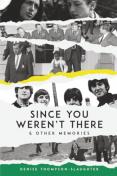
by Denise Thompson-Slaughter
Paperback-
Click on the ORANGE Amazon Button for Book Description & Pricing Info


Overall rating:
How would you rate this book?
Member ratings
Since You Weren’t There & Other Memories, Denise Thompson-Slaughter, author
I enjoyed reading this book because the author’s writing style is conversational and the pages simply turned themselves. The hardest part of reading it was that the author was so far left, it infected her writing. Adjusting to and accepting her views and lifestyle was a stretch for me. Although we are separated by only a few years, her experiences were vastly different than mine. In my home there was no underage drinking; no gambling, and no drugs. I never went bar-hopping. I went to young College Graduate dances. I went to fraternity parties. Free love was not generally acceptable. We lived near our relatives so there were always eyes on us. The supervision was coupled with love and support. Like her, I came from a background of Democrats, although my family became Republicans when I was in my mid-teens. I remained independent, voting on both sides of the aisle until the New York Times produced a fake letter that maligned John McCain with accusations about romance in his private life which were totally untrue.
I never took drugs, engaged in pre-marital sex, or went bar-hopping. I was not a goody two-shoes, by any means though. I defended every lost soul there was and often brought home strays that needed help. I was outspoken, wanted to help people in trouble, and defended the underdog, but I was never into anything amoral or anything just for the sake of attention. I was an idealist, but I did not need or want to break the rules to bring about change. I wanted to help people, through personal effort. I had a foster child. I did not defy the system, though it seems that the author often did. The prevailing moral and ethical standards seemed to be head and shoulders above the author’s standards. Love was neither free nor for sale, as it is today. My friends and I chose spouses and partners with far more care than choosing a head of lettuce, which is more than can be said for some couples today. In most families, divorce was unheard of, especially if there were young children.
The author moved out of her family homes to her own apartment at age 18. She engaged in relationships with inappropriate partners in her teens. She married disastrously as a teenager. Disobedience of the kind she exhibited, experimentation with drugs, traveling with strangers, cavorting around without a moral compass, was out of the realm of my imagination. Perhaps, I had more direction and structure than she did. I was taught to follow the rules, to be obedient and respectful. Although I was an idealist, and so sometimes spoke up out of turn, I never defied the rules by participating in protest marches for causes I neither understood or knew enough about, as the young people in the author’s circle did.
Her generation, just a bit younger than me, became activists. Did they know why they were protesting? They just seemed to be having fun. She and her friends were often high on something. They had a very loose set of values and lifestyle and rarely thought about the consequences for their future. I began to believe that their lack of moral values and immorality, the acceptable abuses of their generation may have been the catalyst that led to today’s lawlessness and protests that have turned justice on its head. Our society often seems to be governed by those with dysfunctional dreams and demands rather than by a moral compass with what was once considered normal standards. The abnormal have achieved a level of acceptance beyond anyone’s imagination. The author’s worldview, however, is compatible with today’s worldview.
The author and I remember similar events but we remember them differently. I would never have gone to Woodstock, which I learned from her book was not even in Woodstock, but in Bethel. I would not have slept in the woods or in a car with boys. I would never have dreamed of experimenting with drugs, although I was once a smoker because it was acceptable when I was young, unfortunately. I was already married with two children when she went to Woodstock. None of my single friends or relatives or acquaintances attended, although they were all within ten years of her age in both directions, younger and older. As years past, I only learned of a few odd people who even experimented with marijuana. No self-respecting female or male would leave their parent’s home until marriage or they were gainfully employed and independent, a goal we all shared. We became adults earlier to cease being dependent on others. Today, that is an anomaly that I believe the author’s generation has inspired. It seems sad to me that this author’s book seems to indicate that while the fifties and sixties were amazing years to grow up for some, it also ushered in the beginning of the end of our once moral and ethical lifestyle. We had the freedom to move about that no young person has today. We played in the streets with boys and girls. We did not look over our shoulders in fear, but trusted that we were safe. Parents were not negligent or arrested if they let their children play outside, alone. In those days, we grew up a bit on our own, and we seemed better for it. It was rare for someone to be “depressed” unless there was mental illness. We grew up to be independent and we thrived, with little trauma, at least in my world. We valued life.
I do remember the days of “duck and cover” in the schoolroom, the fear of a nuclear disaster that was ever present, the terrible assassinations of a President, his brother and a civil rights hero, the military draft, the Pentagon Papers, the moon landing, the Vietnam war, and the awful way the soldiers were welcomed back home with disdain by the same liberals today who view everything about America with disdain. However, I remember those times more positively than the author. I never thought the moon landing was faked, my circle did not march against the Vietnam War. I never disrespected any soldier or law officer, especially if they were serving this country or its citizens. I never resented the five of us living in four rooms with one bathroom. I thought we were just fine, not poor. Before my dad would take us out for a treat, he would take us to see the neighborhoods of people who had less than we did, so we would appreciate what we had and understand their plight. We learned to respect others. Like the author, I remember the excitement of the rock and roll shows and the teenage crushes, but unlike her, I remember the fraternity parties, my college life and love of learning, getting married and eventually being able to travel the world, raising wonderful children and living this wonderfully long and happy life.
Why do I seem to remember a life that was far more fulfilling, although there were also traumatic events in my life, spiritual, mystical events as well? I think it is because we both made very different choices. My family had a terrible car accident, like she did. The car was totaled. The non-English speaking Hispanic immigrant driving, had passed the stop sign. There was no mandatory insurance. We suffered injury and financial loss. It is reminiscent of many situations today that this author would commiserate with, as she seems to identify more with the suffering of the immigrant who should never have been driving, than with the victims harmed. We were all just grateful that they got us out of the vehicle alive.
My local world was different. Families were intact and upwardly mobile, although not professional, in most cases. One friend’s father was a bagel baker, another worked in the Navy Yard, another was a policeman. One friend’s father had a check-cashing business, one was a parole officer, and one was a teacher. One of my friends was a Miss Subways. I remember Elvis, the Beatles, and the Everly Brothers. I was in love with them all and with Joan Baez and Judy Collins, but I never went overboard. I was too busy studying and working because I needed to succeed to get into college. I only had one friend later in my life whom I learned was a “flower child”. Even when I knew her, she never really grew up. She still dressed like a kid carrying a peace placard that said Make Love, Not War. I only knew one person who took LSD and only a handful of people who tried marijuana. I didn’t have lots of extra money but I had direction and a strong home life. I suppose she did not, because, although precocious, she pushed the envelope too far, early on. I can only assume, from her book, that the “fifties and sixties” generation of “protesters” created the dysfunction we are witnessing today.
I think the author came late to the party and was lucky that her life turned out as it did, because she made a lot of foolish decisions. Perhaps it is time to stop screaming at phantoms, even as we memorialize them. The radicals that were once held down in the more stable environment of yesteryear, that were once the minority in society, have grown in numbers. I don’t agree with the author’s worldview. I was devastated by the assassinations of Martin Luther King, John and Robert Kennedy, but I would never justify or support any violence like that being encouraged by the left against President Trump. Islamic terrorism is not the same as the behavior of our police officers, soldiers or ICE. Republicans are not fascists. Open borders and homeless on the street should neither be acceptable or the norm. The treatment of the illegal immigrant is in no way comparable to the treatment of the victims of The Holocaust. The author dismisses the Holocaust as if millions were not murdered and tortured by the Germans. Does she believe that immigrants are being tortured and murdered by ICE agents? Not all Americans, like the author, agreed with draft dodgers or anti-war protests. Many were very upset with the people who turned against their own country, defending the enemy, like Jane Fonda. Like the author, however, I was part of the first generation in my family to go to college, the first to fly in an airplane, the first to move out of state away from my family, etc. I never resented my life, my family or my country. The author, early on, filled her life with self-inflicted trauma, and at times I felt that she has carried a bit of that chip with her for decades, even though her life has blossomed beautifully.
I do recommend this book because it will make you think and wonder, and perhaps it will make you grow in ways you never anticipated.
Book Club HQ to over 90,000+ book clubs and ready to welcome yours.
Get free weekly updates on top club picks, book giveaways, author events and more