




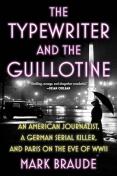
by Mark Braude
Hardcover-
Click on the ORANGE Amazon Button for Book Description & Pricing Info


Overall rating:
How would you rate this book?
Member ratings
The Typewriter and the Guillotine: An American Journalist, a German Serial Killer, and Paris on the Eve of WWII, Mark Braude, Author; Karen Cass, narrator
The book is easy to listen to because the narrator has a pleasant accent and tone of voice. She uses it well and places stress and emotion appropriately throughout the pages of the book. The print copy will afford greater detail as far as the spelling of certain words and more easily allow the reader time to pause and research the information they are not fully aware of, if they are so inclined, like me. The novel is interesting, as it is a perspective about a period of time in which Adolf Hitler rose to power, and how he was perceived by the general Parisian public, but it was more detailed about the life of Janet Flanner, a writer for the New Yorker magazine.
I expected a bit more out of the book, from its title. The book, however, was less about WWII than it was about Janet Flanner, a lesbian in a time when the lifestyle was shunned, and her many romantic relationships. Her bravery for living life her way is highlighted, although she felt it necessary to live outside the United States to live more comfortably.
I felt as if the serial killer and WWII were the bookends to the story and were far less important to it than Flanner’s lifestyle. While it is true that she was courageous to follow a lesbian lifestyle in a time when it was reviled, it was not really what I hoped to read about. She did contribute somewhat to the news of the times, I think, but she was not a journalist in the way I expected her to be. She was not a war correspondent and although she was in many areas of the war zone, many times it was due to an effort by herself and her partners to reach safe havens. Quite frankly, I had never heard of Janet Flanner or Eugen Weidmann, prior to reading this book.
Paris, Weidmann and Flanner did make for interesting reading, however, if you simply wanted to entertain yourself with a book. If you were looking for more detail about the actual war from a person you thought would be actively involved in following it, you will be disappointed. Too much of the book is devoted to supporting Flanner’s lifestyle and not enough is spent on the World War that I was interested in learning more about. The book does begin powerfully with a description of the last public beheading in Paris. Guillotine executions did not come to an end afterward, but they were no longer public. It then moves on to Janet Flanner’s life. She lived with her partner, Solita Solano, in the early 1920’s and remained with her for most of her life, although she did take on additional lovers. The book explains the founding of the New Yorker by Jane Grant and Harold Ross. This magazine provided Flanner with her lifetime career, one she truly enjoyed. She began by writing a column, The Paris Letter. It lightly informed the public of the news happening in and around Paris. To me, more than journalism, I thought it was like a light-hearted gossip column. She was a trailblazer in a city that allowed those who felt unaccepted in America to live more comfortably. Even blacks returned there after the war when they discovered that racism was still alive and well in the United States, regardless of how much they had sacrificed to support America in the war effort, but it was far less of a problem in parts of Europe.
So Flanner was able to meet and mix with names that became familiar and famous, like Ernest Hemingway and Nancy Cunard, Gertrude Stein, Alice B. Toklas, etc. She wrote about Hitler’s election as Chancellor. She wrote about the stock market crash and the Depression, lightly covering its far-reaching devastating effect on Europe as time passed. She watched Hitler’s early rise to power and the people’s inability to recognize how dangerous he was, since they often dismissed his success as an aberration, believing he would fade away. She wrote about the antisemitism she witnessed, the violence and the barbarism. She wrote about her own efforts to escape from the dangers of the war.
My biggest takeaways were these: Wiedmann, the serial killer, had a great deal in common with the Nazis. They were both evil, and for sure, the National Socialists were serial killers too. However, Weidmann seemed to have a “come to G-d moment”. He showed acceptance of his guilt and also remorse. He hoped his G-d would forgive him. The Nazis, for the most part, never did, and they still worship evil. Unfortunately, today, the term Nazi is bandied about with abandon and that serves to diminish the memory of its violent past, for some people. The other take away was a description in the book of right-wing rioters, essentially concluding that when they realized how many people agreed with them and were willing to support their hate and violence as Hitler gained more and more power, they became more organized. I fear that in America today, in the 21st century, we are witnessing such mass hysteria once again, but this time, it is coming from the left. It appears that this kind of barbarism may come from any direction and the same problem persists, some people will follow those leaders blindly. There is an inability for those involved to recognize their own complicity in the evil they are supporting, and there is an inability of those that don’t agree with the revolutionaries to recognize their actual danger.
Book Club HQ to over 90,000+ book clubs and ready to welcome yours.
Get free weekly updates on top club picks, book giveaways, author events and more