




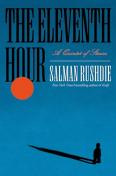
by Salman Rushdie
Hardcover-
Click on the ORANGE Amazon Button for Book Description & Pricing Info


Overall rating:
How would you rate this book?
Member ratings
The Eleventh Hour: A Quintet of Stories-Salmon Rushdie, author; Sanjeev Ghaskar, Nicholas Khan, Sid Sagar, Naveen Andrews, Neil Shah, narrators.
What a pleasure it was to read these stories. Carefully, most often without extraneous dialogue or description, Salmon Rushdie has put his finger on exactly what society has become; in doing so, he has shown how it has deteriorated, even as technology has improved, almost in spite of the improvements, or indeed as a direct result of them. The first story in “The Eleventh Hour” foreshadows the messages of the rest of the stories. They are about the lack of communication, the loss of our freedoms, the power of money and the short distance that exists between life and death.
Our language has betrayed us; the power of conversation and discussion have all but disappeared as we have lost the ability to communicate, and instead, we listen to soundbites and repeat them, regardless of whether they are true or false. We misinterpret the meaning of freedom and misplace our loyalties with those who are not trustworthy. Instead of seeking redemption, rehabilitation and reform, we often seek punishment, vengeance and schadenfreude. We have placed our faith in false G-ds and those with clay feet.
The book concentrates on our life’s struggles, dealing with good and evil, exercising the power of forgiveness or condemnation. It seems to have become ever easier to cross the line from one to the other, from honor to infamy. In each story there is a moral lesson based on how we have lived and even how we will face our death. Subtly, humor is injected into the stories, as our behavior, loyalties and deceptions are mocked. Our author also inserts ideas and people from his previous books, from his own life and from our world history. He has truly exposed the decay of society and the human spirit. I was hard-pressed, however, to find a hopeful message.
In the first story, two elderly men communicate by arguing, ultimately never really communicating. In the second story, the characters attempt to control and manipulate each other, motivated by greed, power and the need for attention rather than merit and competence. In the third story, as a man reviews his life after his death, he realizes how he has been wronged, though he was a good man, but his need for revenge flies in the face of the idea of a good man. In the fourth story, a man meets his own self and discovers whether or not he has measured up to expectations and finds himself wanting. In the fifth story, I was reminded of the quote from Shakespeare, that “All the world's a stage, And all the men and women merely players; They have their exits and their entrances; And one man in his time plays many parts…"
In a sense, each of these stories challenges that quote. When we finish the book, we may ask ourselves, which part would we play or have we played? What part of each of these stories represents our own lives and history, our own flaws or good qualities. Is everything we do based on acquiring fame, wealth and power? How have we faced trauma, emergencies, illness, tragedy, difficult choices, life and death decisions? How do we feel about the freedom to own a gun, bear a child, speak our minds, cross our borders, choose life or death, to hide or to live out loud? In every story, these questions arise. In each of the stories, there is a character that considers success, failure, revenge, mortality, greed, choosing wisely or unwisely, facing consequences, and dealing with regrets. Each story can test our own resolve. We are all flawed.
Have we lost the means to communicate honestly, so that all we do is argue and promote discord, compete and manipulate? Do we listen to the loudest voice, crowding out all others, or search for true meaning? Do we silence those we disagree with? Do we choose the easiest path to follow even when it is the least satisfying? Do we face the end of our lives by reviewing the beginning. Does the idea of “good character” have meaning any longer, or is achieving status and wealth the overriding principle guiding our lives? Has the idea of faith lost its meaning? Are we all both good and bad, uncertain about which rules to follow?
I truly enjoyed the book and the thoughts it presented to me. It seems to be a metaphor for the way we communicate today, a parable exploring social interaction, or an allegory shining a light on what is wrong with life today. We no longer engage in dialogue. We allow only one acceptable idea. Power has been abused. Our words have become meaningless as acceptable meanings have changed. Soundbite messages prevail, prevent critical thinking and teach us nothing, as we forget our past and march into an unforgiving future.
Book Club HQ to over 90,000+ book clubs and ready to welcome yours.
Get free weekly updates on top club picks, book giveaways, author events and more