




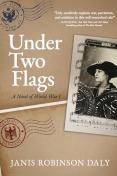
by Robinson Janis Daly
Paperback-
Click on the ORANGE Amazon Button for Book Description & Pricing Info


Overall rating:
How would you rate this book?
Member ratings
Under Two Flags-Janis Robinson Daly, author
Unlike many books about women during wartime, this one is different. It is not about a spy or an underground worker, instead it is about a young woman from Boston, an aspiring opera singer like her mother had been, who was given the opportunity to study in Berlin, during wartime. It is about the choices she made and the life she experienced while she was studying in Germany during volatile times. It is a book that is written to honor women’s contributions and their courage.
Josephine Therese Marzynski’s is an obscure figure. The author has created a narrative about what her life must have been like while she studied in a war-torn country that was an enemy of her own. Her music studies were cut short when her father passed away unexpectedly, throwing the family into financial straits. Her mother had lost the opportunity to study voice when her father took her family to America, and now, she too would be forced to end her dream of becoming a star performer. Then a dear friend of her mother’s invited her to live in Germany, with his family, so that she could study at the famous music conservatory there. Klaus Muller offered to pay for her first year in full. He was highly respected within the government, and 18-year-old Josephine would live with his family. It was at the end of 1916. Germany was at war, but America was not. The family decided to allow her to leave them. Her sister was forced to remain at home and help support her mother and younger siblings. Was Josephine selfish, I asked myself? She wanted her sister to give up her dreams so she could realize hers.
Eighteen years old, naïve and sheltered; she was, as expected, frightened but eager. All went fairly well, although she was sometimes humiliated by Germans who wished America would support them and not remain neutral. They did not take kindly to foreigners. To Germans, neutrality meant against. Thus, when America entered the war against Germany, although her benefactor was able to protect her in a limited way, she was now an enemy alien. She was an American in Germany, and America was at war with America. This is what the author believes is a possible story of her experiences during the war, first as a student at the school, then as an “immigrant” citizen from a country that became an enemy of Germany. How was she treated by her hosts and the country and its citizens? I believe that the author wanted to show how courageous a young woman could survive in times of danger. She did show that Josephine was resourceful, sometimes far more mature than young women of the same age today, but sometimes far more naïve and foolish. Josephine endured the rationing, the interviews, the harassment and the fear during the time she was in enemy territory, but she also has luxurious reprieves not offered to most Germans or foreigners because of the friends she made and the influence of her host family. She was sometimes dangerously haughty and immature, as well, sometimes putting those she associated with in danger, including the Mullers, the friends of her mother with whom she lived. Her arrogance and loose tongue often overwhelmed her decisions, highlighting her willfulness and not her courage. Bringing an American flag to display in inappropriate places, even in secret, seemed like a very unwise choice. However, it did impress upon me, totally, about how consumed she was with patriotism and her love for America. She was proud of being kind of an “immigrant” in Germany, respecting and admiring the people she interacted with and befriended, but she completely supported the decisions of her own country and its military.
I found that I did not get to know much about Josephine but rather learned about a character that seemed to be made up out of whole cloth. She was moral, but not above bending rules to benefit herself. This is is very little known about the real Josephine, and I admit, I wondered why the author chose this particular young woman to feature. Perhaps there are few to choose from, because there is not enough information available about the women in that time who traveled abroad. Often, Josephine seemed like a rube, unaware of the danger she was in, and so she behaved foolishly. At other times, she showed reserve and resilience, courage and strength, choosing her words carefully and behaving in a way that would not cast suspicion upon her or those she interacted with; at other times, she was headstrong and rash. I had to remind myself that this behavior is all assumed by the author, and not in fact, reality. So the author showed what possibly happened, and she showed how Josephine might have managed her time as a young woman in enemy territory. Is it realistic, especially in light of what we know today about war and women?
In revealing what the author believed was the experience of a rather obscure teenager, during just over a year in a volatile and hostile country, Daly highlighted, for me, what is missing from today’s young women and citizens in general. We are living in a country in which patriotism has been dying a slow death and desperately needs a rebirth, especially now, as the world is going through the trauma of conflicts everywhere, including in America. Uniting against an enemy is the main theme of Germany’s citizens. They did not question, nor did they protest their country’s efforts. Right or wrong, they supported its goals and its needs, suffering while they did so because of their devotion to Germany. Josephine was a fish out of water in Germany, not a native, just a guest. Immigrants in America could be called guests, and is their devotion now questionable? We are a country of many people of different backgrounds, men and women, who do not feel the loyalty to America that the Germans and Josephine felt to their homelands.
I hope that this book, rather than shining a light only on the courage that women are capable of showing, also illustrates that we have possibly lost those most important character traits of a country, courage and loyalty, and we in America need to reinspire it quickly.
This is a book that I would recommend for high school students, young adults, and even middle school children, to inspire them to love and respect their own country and its history. First, however, our schools need to start teaching our history and to encourage love and respect for our country. We need to stop teaching our young how to be activists and protesters. We need heroes and heroines, instead. Ours is the best country, and it is why everyone tries to get here. We, who are here, should start to appreciate it and to defend it.
Book Club HQ to over 90,000+ book clubs and ready to welcome yours.
Get free weekly updates on top club picks, book giveaways, author events and more