




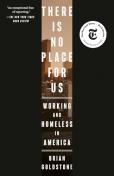
by Brian Goldstone
Paperback-
Click on the ORANGE Amazon Button for Book Description & Pricing Info


Overall rating:
How would you rate this book?
Member ratings
There Is No Place for Us: Working and Homeless in America, Brian Goldstone, author and narrator, Dion Graham, narrator
This is a well-researched book. The stories are thought-provoking and heartbreaking at the same time; it is also documented very well and often reads like a novel, not like an exposé on America’s failure to house what the author refers to as the “unhoused”. It does, however, only present one-side of the homelessness problem, so it left me searching for the other side. The author supports government assistance and a reform of some policies to make it easier to get help for those in need. His goal is virtuous, but it does not address or offer realistic and concrete viable answers to solve the root causes of homelessness. The problem is that he seems to blame the failures mostly on one side of the political spectrum while ignoring the actual left-wing policies that have brought about much of the vast increases in the homelessness issue. The open borders have increased victims, healthcare costs, drug addiction, the number of homeless children, homeless mentally ill, and the homeless who are working but cannot make ends meet. Available funds meant for citizens have been stretched to their limits because the system has been flooded with illegal aliens who don’t speak English and have difficulty assimilating as they absorb the benefits meant for legal citizens. The outdated laws and regulations make the solution an endless Kafkaesque journey, even for those who truly deserve the benefits provided. The system encourages the cycle of homelessness because there is really no one truly in charge who can make the appropriate decisions without having to deal with the government’s endless red tape. The funds allocated are limited, the varied housing alternatives allocated to help are limited and often sub-standard, the rules regulating each housing venue are different, and this is made worse by the inflated homeless rolls due to the millions who have illegally entered America under the Biden administration. Calling these millions undocumented does not change the fact that they are here illegally. They stretch the minimal services available beyond capacity. The author does not take note of this, instead, he almost always ignores the irresponsibility of many of those who, in fact, though not being served well enough, may not be eligible for services.
The tenants and landlords, the administrative organizations and the corporations, all engage in unfair accusations and problem solving. The homeless are more often treated as statistics and not as human beings by the bureaucracy. Archaic laws, uncompassionate, overworked and underpaid employees are also sometimes unqualified for the very important jobs they hold. They cannot even offer helpful solutions when they discover errors because they have no authority to alleviate the suffering of the victims of homelessness. The system demanding low rents and/or free shelters, does not take into consideration the fact that the landlords need to be paid if they are expected to maintain the premises they rent. During Covid, there were many abuses on both sides. Tenants couldn’t work, so landlords weren’t paid the rent. The facilities suffered, as did those who were unfairly evicted and made homeless, making the situation far worse. It was a catch 22. Tenants and their supporters demanded a rent furlough, but the premises were required to meet certain standards without the funds to make that happen, and the required paperwork was a morass. There were some landlords who abused the situation and took advantage of it to rid their residences of scofflaws. Many were unfairly penalized.
The stories of the families in this book concentrate largely on the females, since there is only one couple included in the book. Their challenges will touch your heart and make you angry at the “powers that be”. While it is true that gentrification has forced many poor people out of their neighborhoods and into shelters and it is unfair, Goldstone did not really explore the social problems that cause the homelessness of so many. Unwed mothers who are children themselves are not equipped to care for themselves, let alone other children. The fathers seem unaccountable and get away without any responsibility for the child they planted. It should be a given that children should not have children. Wanton sex and single mothers lead to unstable homes. The mothers generally leave school, are poorly educated, and are perfect candidates for poverty and welfare. Their children are often deprived of basic necessities because they cannot get gainful employment and cannot afford adequate housing. These children often become runaways or grow up to be troubled adults who are also homeless. Living on the streets may be a result of drug addiction or it may lead to it. It is a dangerous lifestyle, as are many of the shelters promoted. They are poorly run and unsupervised. There is inappropriate security, so some prefer the street. The author blames the system’s red tape that prevents the swift re-housing of those unfairly evicted or in need of a home. He is truly justified. Still, if the children weren’t having children, this problem would be far less imposing.
I lived in a neighborhood with a housing project. The people who lived there often abused the property. Then they complained about the necessary repairs that were not being made. Might their behavior be one of the reasons why the landlords stopped maintaining the rental units as well as they could? Of course, there are unscrupulous, greedy slumlords too, but there are also unscrupulous tenants. Rent controlled and rent-stabilized programs were set up to help keep people in their homes and were designed to help keep rents affordable, but people like Representative Charles Rangel abused the system. He had four rent-stabilized apartments in Harlem, and he believed he deserved them. Others disagreed, since many lived in substandard housing and were on waiting lists for better accommodations. His rent was half the going rate, so if it wasn’t illegal, it certainly was unethical. There was no mention of this behavior in the book. For me, the number of homeless people is far less important than the reason why there are so many homeless. The system was set up to serve the needs of the poor, the hardworking citizens who just didn’t earn enough. The program was abused. Often, as noted, the very politicians who demanded the benefits for the poor, coupled with those who knew how to work the system, used it to benefit themselves.
Many of the people highlighted in this book are victims of a system that has exploded beyond its natural borders because of the handouts. It often became more beneficial not to work. In the real world, responsible people do not have children they cannot afford, unless it is an accident. After they make one mistake, they try not to make another. In this book, many went on to repeat the same poor choices and make the same mistakes, even having additional children they could not afford. They expected more handouts, however. They exacerbated their own perilous situations. The results were heartrending, but when does the reality hit? Those featured in this book seemed to be not only victims of their own poor choices, but victims of the government’s incompetence and inadequate responses to their problems. They are truly the victims of a system that does not serve them well, especially in times of emergency like the Covid Pandemic, but the problems of these families began way before the pandemic. Our education system, largely controlled by progressive and liberal views has failed them. They were not taught life skills as much as they were taught activism and victimhood. That education created irresponsibility and perhaps hopelessness which led to poor choices. They were taught that their failures were due to someone else’s behavior. They needed to protest the situation. It was not their own fault. This system justifies their failure, so it is expected by them, and success becomes an even more distant goal. There is only one way to solve this problem, but it is not with more socialism. We must address how we actually arrived at this treacherous crossroad. Goldstone never seems to do this with the clarity it deserves. He seems more interested in offering a compassionate response to an awful situation, rather than to deal with the harsh reality and offer hard advice that might offer a solution. He simply wants to throw more money at it, but that is like throwing gasoline on a fire. For every one of the families that he cites that is deserving of social services, there must be dozens more with similar stories. Money will not solve the problem, lifestyle choices will. Many are abusing the system because they feel abused and thus justified. It ruins it for others. You have only to look to the issues in Minnesota today. Somali fraud has emptied the coffers meant to help the suffering and the needy, and this fraud is not only in Minnesota. The system is being gamed by the very people it is designed to help. Where are the safeguards that should have been built in, at least to limit the fraud? Where are the honest politicians overseeing these programs, they designed?
Although the author did not pay anyone to contribute testimony, he did offer what to him were minor rewards. To the recipients, they were perhaps a lifeline. Food coupons, gas coupons, etc. gave them the wherewithal sometimes to get through another day. These people were challenged by the very system designed to help them. The system has failed. The laws are abusing many victims who are homeless, often by circumstance, definitely not by their own choice. The profit motive, a component of capitalism, oftentimes corrupts those who are greedy. I have read a similar exposé, by Matthew Desmond, “Evicted: Poverty and Profit in the American City. It is also a Pulitzer Prize-winning non-fiction book. Since the problem has worsened in the last decade, since it was written, the books need a broader audience and a far better solution than blaming the system. This is not a new problem, nor a problem that has been ignored. The homeless population is undercounted because of the methods, just as the illegal alien problem causes an inflated census allowing those who continue to exacerbate the problem to have more representation and to be in charge. When the author cites one of the homeless victims who gets a check for the wrong amount, he doesn’t make any comment on the fact that she knowingly cashes a check she did not deserve. Instead, he makes her seem virtuous because she attempts to share it with others in need. Is that behavior acceptable? Can a person be just a little bit pregnant? Although the book makes it seem like this is only a problem for the black population, that is an unfair assumption. He cites someone who is unfairly being charged for her water use. I had the same experience, and I am neither black nor an Atlanta resident who is homeless. I was also forced to pay the bill, although it was not mine. Fighting the bureaucracy is daunting for everyone. Let’s get rid of the stupid rules, the red tape, and limit government involvement in our lives. Without big brother watching, maybe we would be more responsible and engage in activities that help each other.
The book was too long by half and became repetitive. The five families highlighted could be anywhere, not only in Atlanta. People prey on each other regardless of color or financial situation. We are all subject to scammers who prey on the vulnerable. I think that terms like cost-burdened, undocumented, and unhoused cannot disguise this ugly problem or make it more palatable, it can perhaps diminish its importance. Wrongdoing must be recognized, not justified. Although all of these people in the book were working hard to get ahead, they sometimes defeated themselves with poor choices that they kept repeating. Children are not toys. Sex is not a substitute for real relationships and love. So, while many of the families did not seem to deserve their fate, they seemed to be searching for happiness and answers in the wrong places. The book seems to rely a great deal on the author’s interpretation, the opinions and the memories of both his subjects and himself. It might be feasible to assume that some liberties may have been taken regarding the anecdotal revelations. A book with a different view of homelessness, addressing actual causes and lifestyles that contribute to homelessness, that might not be as sympathetic to some of the victims, would most likely not see the light of day for it would probably not be published.
In conclusion, the broken system pales when compared to the broken people.
Book Club HQ to over 90,000+ book clubs and ready to welcome yours.
Get free weekly updates on top club picks, book giveaways, author events and more