




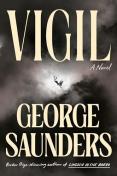
by George Saunders
Hardcover- $25.00
Click on the ORANGE Amazon Button for Book Description & Pricing Info


Overall rating:
How would you rate this book?
Member ratings
Vigil, George Saunders, author; Read by Judy Greer and Stephen Root with MacLeod Andrews, Kimberly Farr, Mark Bramhall, Barrett Leddy, Eric Jason Martin, Karissa Vacker, Sunil Malhotra, Cassandra Campbell, Kimberly M. Wetherell, Aaron Goodson, Maggi-Meg Reed, Marni Penning, Rebecca Lowman, Matt Godfrey, Fred Berman, Kirby Heyborne, Ann Marie Lee, Danny Campbell, Vas Eli, and George Saunders.
Before I begin, let me warn the readers that have reached their own “sell by” or “use by” date in their normal lifespan, this will be a depressing walk through memory lane. Even a healthy human, unaffected by disease, especially one like Cancer, which eats the body and often the mind, has an expiration date. We are all born with one; most of us simply do not know it, I think most of us do not wish to know.
When the story begins, there is a wedding occurring next door to the house where a man, some may consider evil, some may consider their hero, lays dying, refusing to acknowledge any wrongdoing he may have committed in his life, believing he has been a good son, husband and father and a very good businessman. So, in one house, while a wedding and the joy of life with a bright and hopeful future is looming, in the other one, the end of life is looming as death approaches this very broken, very sick and dying man, one who seems unable to come to terms with the wrongs he has committed, until it is seemingly too late. In one home they are celebrating the coming days and in the other the end of days.
Jill “Doll” Blaine has been sent from above to keep vigil over K. J. Boone, to comfort and/or enlighten him so he may move on in peace from the natural world he will briefly inhabit a bit longer, to the unnatural one of death and nothingness. She tries to help him show some remorse for the errors of his ways so he will not be led off to a fate, in death. that continues to be painful or unpleasant. Boone is visited by his grieving family and his former associates who have died, some who have waited to take out their grudges in death that they could not achieve in life.
Because there is no definitive knowledge of our lives after death, there is no definitive explanation that I could fully fathom from the author’s philosophy, albeit he did offer both the dread and the inevitability of death in a somewhat palatable way. I felt that as Saunders contemplated the effect of death on mere mortals, he had little faith of it offering either any kind of positive afterlife or any hope of us rejoining those we love who have passed and going off happily with them into the sunset.
Jill “Doll” Blaine was very young, only a year into her marriage and in her early twenties when she was blown up and killed. Her plans for a fruitful life ended suddenly and unexpectedly, like so many before and after her. The person responsible was still alive at the ripe old age of 90+ which hardly seems fair. Now, in her afterlife, she is charged with descending to earth to comfort and aid the dearly departing, helping them to pass from one realm to another more easily. Because no one has ever returned after death to enlighten us, I found the author’s take on it is sometimes confusing. As we learn about the life and memories of the dying man, Saunders uses Boone’s background as the medium to espouse his own political views. Apparently, K. J. Boone had been the leader of an oil business responsible for harming the climate. The more successful he became, the more egregious was his behavior, but Boone himself thought he was doing well and had no concerns about what his business was doing to the climate or those adversely affected by the negative climate change he was supposedly contributing to or causing.
As we explore the life and the memories of both Boone and Blaine, we see the benighted character is within moments of his impending death and is still unable to understand the harm he has done to the climate and the world. Jill is disappointed, a she watches him carted off rather brutally by his dead associates who have been yearning for their just desserts, waiting patiently for their own revenge for his influence on their behavior and ultimate afterlife. Jill has a sudden epiphany. She wants him to be able to repent, though it is too late in the game. The theme of forgiveness suddenly becomes front and center.
Questions arise for the reader. Are we born with a life that we cannot change the outcome of or can we become something other than what we were born to be. Is it possible to follow a path other than the one we are set on at birth. Is greed an appropriate motivator for success and the bending of rules? Is it right to take advantage of some who are weaker to advantage those who are stronger or wealthier? Would it not be better to forgive our sins more easily? Should we be forgiven, however, if we never see the error of our ways?
What do you think the afterlife will be like? Will there be retribution or a pardon? Should there be further suffering after death or peace and serenity? As Saunders contemplates death and how we cross over into the next world from this one, we the living are forced to watch the dying and grieving worry about the next stage for their loved ones and themselves and then to ponder even our own demise.
Book Club HQ to over 90,000+ book clubs and ready to welcome yours.
Get free weekly updates on top club picks, book giveaways, author events and more