




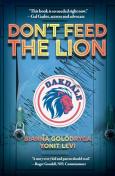
by Yonit Levi Bianna; Golodryga
Paperback- $14.90
Click on the ORANGE Amazon Button for Book Description & Pricing Info


Overall rating:
How would you rate this book?
Member ratings
Don’t feed the lion, Bianna Golodryga, Yonit Levi
I believe that this book should be required reading for elementary, middle, and high school students. If it doesn’t provide the tools, at least it provides insight into an age-old problem, antisemitism and the lack of an appropriate response or even definition. Although the main characters are a sixth-grade girl, Annie, and her 8th grade brother, Theo, this book would be an appropriate object lesson for all ages. All of the characters have to learn to deal with antisemitism, loss and grief, frustration and anger, often without many appropriate tools.
Books like this should be studied more intensely in places of higher learning as well. It is needed in universities where the hate bubbles up to the surface even more readily. There is an urgent need to study the ideology behind the hate, and also the feelings felt and experienced by the haters. It can no longer be hidden, rather it should be dissected and studied and brought into the light in the hope that it can finally be recognized for the disease that it is so it can be cured and eliminated. I don’t have much hope, however, because of recent events.
Coincidentally, while reading this book, with the intent of reviewing it, hoping it would advance the cause of unity instead of the identity politics and alternate theologies which inspire division and hate, I realized this time of year, and the very night I finished the book, is the very first night of Chanukah in the United States. This is a time that is very meaningful in this book, as it is takes place during this holiday season. On the first night of Chanukah, some major problems seem to be resolved for the Walker family. However, another dreadful antisemitic event took place last night, on the first night of Chanukah, at Bondi Beach, Australia. It dwarfed previous events in Melbourne and Sydney that are briefly mentioned in the book. Then, as I finished the book, I remembered that when I first noticed it, it was the title that interested me. I always thought that the lion was a positive symbol in Judaism and Christianity and wondered why it shouldn’t be fed. After reading the book, I think I have come to understand its meaning. I believe the authors feel that by not feeding the lion, you are actually preventing a problem from escalating. Instead of responding with anger, or by disobeying rules, it is better to find a more civilized way to solve the problem that will strengthen the lion and not weaken it. I question the validity of such a premise in today’s world. In a more perfect world, perhaps it is a viable reason, but for certain, I believe that silence is never the answer. Perhaps confronting the issue, rather than hiding from it, is a better way to counteract the hate that exists. I think that the authors believe that by educating the haters, they will reform and see the light. I wish I could agree, but after the terrible attacks on October 7th, 2021, in Israel, and the others that have followed all over the world with the Jews being maligned and the barbarians cheered on, I cannot. I seriously doubt that turning the other cheek and trying to explain that hate is not the answer, but that we are all part of “one team”, or offering gentle, compassionate explanations, DEI training or other excuses, coupled with often useless counseling that exacerbates the hate, will solve the problem. The monstrous attacks and events have continued and have grown worse. Surely, we must be allowed greater latitude to fight back with some kind of aggression to right the wrongs, to end the injustice. It is time to stop condemning the reactions of the Jewish people to the hate they experience and to begin to condemn those that attack them.
For me, although this book, did not offer enough concrete solutions to the problem, it did offer insight, and it did illustrate more widely the deeper problem that exists for the Jewish people. It can no longer be hidden from the children, the wider public or be denied or overlooked by those not directly involved. It must be confronted when it occurs, and for me, if breaking the rules is the only way to get real recognition of antisemitism, so be it. It is justified. Sometimes, the means does justify the ends.
In the book, although I thought that the characters were really authentic, I believe that the treatment of Annie and/or Theo, by the school and their parents, because of their illicit behavior, lacked appropriate discussion and punishment. I think that I would have forgiven them because they had already suffered humiliation and shame, unjustly heaped upon them by either ignorance or actual antisemites, and they had little choice but to fight back with the only weapons they had to use. They were pushed beyond the breaking point, and they were children. Those who pushed them did not face any real consequences or penalties. I thought that although Annie and Theo’s behavior was not exemplary, and surely was against the rules, and though it was certainly somewhat overly aggressive, because the adults did not set an appropriate example, it was their only way to respond to the hateful behavior occurring.
In my lifetime, I have only experienced antisemitism as an adult and a parent. I have seen it ignored and excused; oh, Jews see antisemites behind every bush. I have heard that the hate directed toward them is justified because of the way they behave, but I have seen too little condemnation directed toward the haters and their behavior. Therefore, I believe in responses that are not necessarily equivalent, but instead are so forceful as to prevent the very perpetrators of the hate from doing it again. Those who actively hate have told the world and the Jews that they want to destroy them and their country. Isn’t it about time to take them at their word and to solve the problem, not dismiss it? Israel and the Jews are not the problem, their haters are the problem because they do not want them to exist. Jewish children are not taught to hate or kill their enemies. There are children in other cultures who are brought up with nothing but that kind of teaching. So, turning the other cheek, engaging in conversation or education does not help. If the haters are intent on only one thing, and that is the destruction of the Jewish community, the Jewish community cannot reverse that hate.
I am well aware of the many themes in the book. Changing the name of a person, in my memory, was for a different reason. It was to prevent those who hate Jews from recognizing their name as Jewish, consequently shutting doors to them. When I was told by a carpenter that he was happy I didn’t “Jew him down”, I asked him to explain, announced I was Jewish and showed him the door. I did not feed the lion, but I did not ignore it. Still, I could not do anything when my daughter was refused admittance to a university, and I was told that it was because the Jewish quota was filled, or when a teacher in Minnesota told my son’s class that Jews got to the desert when someone threw a quarter in, because the principal of the school, like the one at Oakdale, minimized its horrible intent. I did not remain silent, however. I sent letters to appropriate places when I witnessed antisemitism at a State Fair, and sent videos of antisemitic presentations by the local television stations to the Governor. I did not always get a reply or one that I appreciated, but I tried to thwart it and change the atmosphere of hate.
The words of the book speak to me with an authenticity that will reach young kids, pre-teens, and even parents who must confront antisemitism in the real world, and although it may not offer a tool to defeat the ignorance of antisemitism and all the other hate that is concomitant with it, it does offer the truth about it. I believe that the book should be promoted to a broad audience in the hope that it will inspire the development of tools that children and adults may use to appropriately and successfully combat and defeat antisemitism.
In the acknowledgements, the author mentions certain politicians and important figures, all on the left, and yet, the one on the right that has done the most for Israel and the Jews, which is acknowledged by Israelis, but because of politics, is not acknowledged by many Democrats in America, the authors seem to have omitted any mention of President Trump. I find that an egregious omission. If a real solution is being sought, then all avenues have to be acknowledged, not just those that appeal to the personal politics of the author. Indeed, the disunity it inspires is one of the reasons that we have hate, at all. Perhaps the well-intentioned authors are unintentionally guilty of feeding the lion.
The person who is afraid to risk anything to stand up against injustice is a coward, the person who confronts injustice is my hero. It is important and necessary for Jews to get control of the message to defeat the people marching against them, even though they are greater in number. We must remember that David slew Goliath. I believe that we must be the Lions of Judah, strong and courageous, and we must rise up against our enemies. Their lies and hate must be silenced.
Book Club HQ to over 90,000+ book clubs and ready to welcome yours.
Get free weekly updates on top club picks, book giveaways, author events and more