




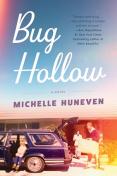
by Michelle Huneven
Hardcover- $21.65
Click on the ORANGE Amazon Button for Book Description & Pricing Info


Overall rating:
How would you rate this book?
Member ratings
Bug Hollow: A Novel-Michelle Huneven, author; Emily Rankin, narrator
This novel follows the Samuelson family. It begins in the mid-seventies when Ellis Samuelson graduates from high school, and at the age of 17, he sets off on a vacation with two friends. When the friends return, they return without Ellis. He has met 19-year-old Julia, and has decided to stay with her and her friends in a place called Bug Hollow. For some unknown reason, he chooses to keep his whereabouts secret from his parents, Sib and Phil, and sisters, Katie and Sally. He does call home to say he is safe and will return home at the end of the summer. He asks them not to worry. He has never been happier. His mom tends to jump to conclusions and is very judgmental. She immediately assumes that he has been lured to a commune and will abandon his dreams of sports and college. His dad is not worried at all, but Sib convinces Phil to put an ad about their missing son in the classified section of a newspaper. When a woman calls to tell them that she knows where he is, they pack up and set off to rescue him! Does he want to be rescued? Ellis has only recently celebrated his 18th birthday, and so he does not have to go home with them. He and Julia believe they are in love and will marry one day, so they talk it over and decide that for their relationship to succeed, going home is the best choice for their future. Ellis returns home, but he can’t wait to leave and returns to school earlier than necessary. That choice changes the trajectory of all of their lives.
The book continues to follow the family and their many relationships for decades. The adults deal with the tragedies that come their way, the children mature and go out into the world, and ultimately the choices and their secrets keep moving them around like pieces on a chess board. Yet, thankfully, for the most part, they never reach checkmate. Somehow, everything seems to come full circle happily. There is no retribution, and there is little remorse, shame or guilt for anyone’s behavior. Everyone seems to happily embrace their own shortcomings and the shortcomings of others, even when they feel anger and disappointment. Forgiveness and acceptance of any and all circumstances seems to be the overriding theme. The law of unintended consequences somehow seems to do no harm to any of them, although each of the characters has flaws. None of them are perfect; they all seem to suffer from being human! Most important is the idea that they all seem to manage whatever life throws at them without spinning completely out of control. The questions all have answers, the problems all have solutions.
From this novel and the lives portrayed, however, these are some of the conclusions one might draw from the narrative. One might get the idea that a person named Baron is not a nice person since Baron is not a nice name. One might assume that an illegitimate child or a child of unknown genetic background is the reward, not the consequence of risky behavior. One might get the idea that Socialism is preferred to Capitalism or that Jews are welcome in Arab countries so long as they make sure to keep a low profile, and isn’t that okay? One might assume that religious and ethnic barriers have disappeared and no longer matter as people marry whom they please and procreate at will. It might be assumed that alcoholics do not need outside help to control their alcoholism or that it is okay to mock immigration laws and ICE. For instance, a same sex marriage that simply represents a deep and close friendship can be performed in order to grant legal status to someone who has overstayed a visa or is in the country illegally. It might even be assumed that someone who misses their cancer screening can expect a diagnosis of cancer and shame on them. Then there is the assumption that a person may choose the time of their death, and it is okay for those who know to keep vigil at the death and to keep it a secret, so long as they do not participate and the person does it entirely on their own. That would not be considered assisted suicide. The line between compassion and judgment is so blurred it is difficult to make the important assumption about whether or not something is really right or wrong.
How the author managed to include all of these approaches to life with a positive spin was mind-boggling for me, Then, I thought, as the branches of this family grew and traveled in so many different directions, in the past and the present, and their relationships were deeply explored in detail, with all of the joy and the grief, was this novel which kept me interested until the very end, essentially propaganda? Was it the author subtly and expertly using this story to indoctrinate the reader with political views? Every action in the novel had a pull and a push. The reader needs to decide whether or not to pull or push, condemn or forgive. Every concept that is presented in this book can be thought about as if it has two sides of the same coin. Abortion rights, immigration rights, end of life rights, treatment rights, religious rights, marriage rights, civil rights, etc., all rear their heads. When I finished the book, I thought about the rights we have, and perhaps, more importantly, I thought about what rights we should be entitled to have.
Book Club HQ to over 90,000+ book clubs and ready to welcome yours.
Get free weekly updates on top club picks, book giveaways, author events and more