




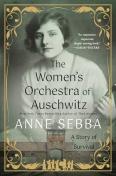
by Anne Sebba
Hardcover- $29.89
Click on the ORANGE Amazon Button for Book Description & Pricing Info


Overall rating:
How would you rate this book?
Member ratings
The Women's Orchestra of Auschwitz: A Story of Survival, Anne Sebba author and narrator,
Helen Stern, narrator
This is not an easy read. I have read so much on this topic, and yet, I have never read about these women. This author, using the experiences of the women, who by the grace of G-d survived because they had a skill, not based on material wealth, has illuminated the horrors of the Holocaust with new details of the barbarism that the victims experienced. It is very well documented so that even the cattle car numbers that transported the slave labor is supplied, and of course, the tattooed numbers of many of the victims is supplied, as well. Auschwitz was the only camp that tattooed their victims. Auschwitz became a series of camps as the war progressed.
Beginning with the invasion of Poland and the “resettlement” of the victims who eventually came from many countries as Hitler’s war expanded (i.e., Poland, Russia, England, Romania, Czechoslovakia, Belgium, France, Greece, Hungary, Holland, and of course Germany), the reader learns of the methods used to erase and murder the Jews, the Roma, the mentally ill and disabled, and it is grotesque. The Kapos, the Commandants, the Nazis, the Germans, the Italians and the Russians (in the beginning), who supported Hitler, usually came from the bottom of civilized society. They were criminals, sadists, antisemites, etc. Many of the memories revealed in the book come directly from the mouths of the victims who wrote journals, books and gave testimony to the Holocaust museums. Anne Sebba has brought their stories into the light of day with details that also trace the entire course of history leading up to and including The Holocaust, and she follows it up by following the survivors into the present. She bears witness to man’s capacity for evil with such detail that the reader is there with the victims. At the time the book was written, there were only two survivors left from that women’s orchestra and one was nearing her 100th birthday.
This book should be required reading because one would hope that no one would ever forget the brutality of the Nazis or the suffering and humiliation of their victims. Yet today we are reminded, that even though we kept the horrendous memory alive, it did repeat itself in another genocidal event on October 7th 2023 when Israel was invaded and the Jews Americans and other foreigners there were slaughtered and many were taken hostage. All of them had been engaged in an effort to work peacefully with their Arab neighbors. Obviously, their Arab neighbors were working at a counter purpose. Today, we witness antisemitism again, as marchers shout “from the river to the sea”, and the countries of the United Nations condemn Israel for defending itself rather than their attackers. The world that promised never to forget, indeed has forgotten.
The women featured in this book did what they had to in order to survive in the Concentration Camps. Many sadly believed that they aided Hitler and his minions because they played music for the arriving victims that were doomed to die, tricking them into thinking they were not going to their deaths or to be worked to death. These women were rewarded with little privileges that the other inmates did not receive. They were given separate quarters with beds and blankets. They had clothing, a bit of extra food, could let their hair grow back and were able to shower. Did that make them complicit in this monstrous event or did it simply help them to survive to tell the world about what these monsters did?
I learned of more atrocities that were committed than I had ever known before. My mother-in-law’s gynecologist was in the very Concentration Camp with these women. Dr. Perla was forced to deliver babies in the infirmary, babies that she knew would be murdered along with their mothers. When she survived, she had the courage to continue to practice medicine, saving lives instead, delivering babies who would survive. Most of the women that survived the camps went on to have families and productive lives, but many remained haunted by nightmares about the sadism, torture and death in the slave labor camps. Many remained silent, unable to describe their experiences which they said no one could possibly comprehend unless they had been there. At the end of the book, the author seems to indicate that the orchestra saved only about 40 victims, but it really did so much more because these same survivors tried to rescue others in the camp in whatever way they could.
In the camps, life and death was arbitrary. They witnessed the horror of people being sent alive, into the ovens of the crematoria. They participated in sadistic roll calls, standing naked in freezing temperatures. The nearly dead collapsed and were covered with water so they would freeze to death. They witnessed prisoners being beaten to death for sport. They suffered from thirst and starvation and the indignities of lice and raw sewage all around them. Some women had formaldehyde injected into their uteruses, without anesthesia, to prevent them from infecting the world with more Jews. They were so hungry that there was even evidence of cannibalism in some camps. When they were liberated, bodies were discovered with missing organs or body parts. The depravity of their captors made them so desperate that they sometimes became as cruel to others as their captors were to them. Some soon preferred death and walked directly into the electrified fences causing instant death. Some realized, instead, that while there was life, at least there could be hope, and they desperately hoped the war would end and they would be freed.
Some thirty years after the war’s end, some of the survivors found each other and every year thereafter, they managed to contact each other in some way on April 15th. Soon, their memories will disappear with them. Ironically a piece of music they played became the national anthem of Israel. Hatikvah means hope, and we hope that we will all live in peace one day.
This book delves into the history, the events, and the mindset of the monsters as well as their victims. Did they realize how evil they were? Today, I question the innocence of any those involved. The stench and the smoke from the crematoria were inescapable. Even without the internet and social media, word most likely would have spread. Was it simply ignored by people and a world willfully and selfishly blind? The system was obscene. The participants were inhuman. The victims were made to believe they were inhuman as well. If they did what they had to do in order to survive, did that make them collaborators?
The reader’s tone is appropriately mournful and thoughtful but page after page it becomes more and more difficult to learn of the unspeakable horrors revealed. Still, the reader will not be able to stop reading, and this book will leave its mark on every reader. It is devastatingly honest and brutal. Would any of us have had the courage or the fortitude to survive if we had a skill or a talent? Could we have entertained our torturers? Could we have maintained hope? Would we have walked into the electrified fence? The women tried so hard to survive, but rarely fought back. Today, it is different. All Jews will fight back.
Book Club HQ to over 90,000+ book clubs and ready to welcome yours.
Get free weekly updates on top club picks, book giveaways, author events and more