




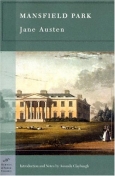
by Jane Austen
Paperback- $6.25


Overall rating:
How would you rate this book?
Member ratings
I would recommend using Spark Notes to help you get through this book.
Difficult to read---some sentences go on for 9 lines. Doen't measure up to Austen's oth books.
Mansfield Park is one of Jane Austen's best books, with beautiful prose and interesting characters. It's not as entertaining as P & P, Emma, S & S. The first half is somewhat tough reading, but it's worth it. Jane was at the peak of her craft when she wrote it- deeply thoughtful.
Mansfield Park, Jane Austen
First, if you are listening to this novel, have a print copy handy as well. There are times when it feels like it is one long run-on sentence that is difficult to follow. Getting past that, it is a wonderful experience to read sentences that are beautifully crafted, often with double meanings, yet using none of the crude language we often find in books today. Today, so many books are riddled with slang and a vocabulary that once made many blush. As authors and publishers try to lure in readers who have become used to quick soundbites and have short attention spans, they often substitute the mediocre for the exceptional. Sentences have become short and staccato, even politically sensitive, to draw readers into the story, a story that rarely contains hidden nuances, but rather rolls out page after page with a dialogue meant to entice but not to enthrall, to spoon feed rather than encourage critical thought. This book was such a welcome change for it is without foul language, sexual content, political or woke ideology that is constantly being insinuated, of late, and instead it is an intelligent use of vocabulary for the reader to admire and interpret.
In this early work of Jane Austen, she has highlighted the interaction of two wealthy and well positioned families, the Bertrams and the Crawfords. Into this mix, throw in Fanny Price, the child of a relative that the Bertrams take in to raise as their own in order to provide one of their poor relatives with a far better life than her own family ever could. The Bertrams seem to truly believe that this is a sincere act of kindness, but although they sheltered her and provided her with most every advantage that they gave their own children, her accommodations were inferior, and she was sometimes not so subtly reminded of her true station in life. There were obvious family obligations expected of her for their supposed kindness. Fanny understood that she was expected to show gratitude and obedience. She was, after all, subservient. Fortunately for Fanny, her personality was well suited for the situation, and she adapted to her position well.
Deep down, the seemingly quiet Fanny had an independent spirit and in her late teens she began to assert herself. Unable to allow herself to be forced into an unwanted proposal of marriage from Henry Crawford, her behavior was interpreted as disrespectful by those around her. In reality, she was merely voicing her true feelings. Because she came from a lower class, they all believed his offer of marriage was a great opportunity. She could uplift herself, her family, and her other relatives by joining the upper class through marriage. Her refusal of Henry’s generous offer was considered unexpected and ungracious. To her great disappointment, her uncle, Sir Thomas Bertram, the owner of the Mansfield Park estate, the head of the family that had taken her in, was angry with her because she refused to consider Henry. He had, after all, professed a profound love for her. Why did she not appreciate it? Secretly, Fanny had been harboring a deep and abiding love for Edmund Bertram, her uncle’s son, although he too, above her in class, was considered an inappropriate match. He had always been her dear friend and supporter. She believed he did not return her affection, and she would never even presume that he would or could love her. However, the proposal from Henry Caldwell was anathema to her because she did not like his character. Edmund on the other hand was seeking to go into the clergy.
While the reader will never have to deal with crude content or cringe from inappropriate language, every sentence in this novel will present a clear image of the pompous lifestyle and rudeness of the aristocracy. At times, the reader may grow annoyed with both the shyness of Fanny and her alter ego that is obstinate, as she rejects her suitor and deals with the pompous and arrogant attitude of those relatives who believe they are better than she is or that she is ungrateful for not accepting the prize Henry is offering to her. Alternately, the reader may dislike the behavior of several of the more pompous characters, like her aunt, Mrs. Norris, who is often unkind in her interactions with Fanny or Lady Bertram for whom she is like a lady’s maid or even Sir Thomas who often seems disconnected and unaware of the fact that Fanny is not treated as well as he believed.
The lifestyles and arrogance of the aristocracy seem almost comical as they pretend that their letter writing and idle pastimes are important. The way they speak to each other often couches their real meaning, which is far more insulting than the words expressed would indicate, rather they imply one thing and mean another. The English are rather expert at using dignified language to say undignified things. Often, they used a pretense of manners to cover up their real intended meaning. Their air of superiority affected every action they took and comment they made. They pretended kindness and compassion often, while they were really mocking the person with whom they were interacting or the persons they were speaking about. Their formality covered up their true impolite intent as they spoke to each other in what seemed, at first, like innocent language.
It is a book about times gone by, and in some ways it inspired in me a strong yearning to return to civil discourse. In other ways, however, it raised an awareness and disgust in me concerning the old elitist system and how unfair and cruel it was for those barred from entry into that world. Some of that unfairness still exists today, while I think there is hardly a remnant left of civil discourse. When it came down to it, for me, this was a charming and simple love story between Fanny Price and Edmund that seemed to flourish, unknown and under the surface, while they lived in Mansfield Park with relatives who sometimes sabotaged each other while pretending to have nothing but support and love in their hearts. Most of their lives seemed to lack a meaningful purpose or endeavor, and instead, they seemed to always seek ways to entertain themselves with the pretense that they were doing something meaningful and important.
Book Club HQ to over 90,000+ book clubs and ready to welcome yours.
Get free weekly updates on top club picks, book giveaways, author events and more