




BKMT READING GUIDES
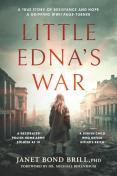

Little Edna's War: The gripping WWII page-turner. A true story of resistance and hope (Holocaust Survivor True Stories)
by Janet Bond Brill PhD
Paperback : 366 pages
0 club reading this now
0 members have read this book
Instead, she became a legend.
At just seven years old, Edna Szurek risked everything to smuggle food through holes in the Warsaw Ghetto wall, knowing each step could be her last. By the age of 10, she was the youngest decorated member of the Polish resistance. ...
Introduction
They tried to erase her.
Instead, she became a legend.
At just seven years old, Edna Szurek risked everything to smuggle food through holes in the Warsaw Ghetto wall, knowing each step could be her last. By the age of 10, she was the youngest decorated member of the Polish resistance. And by the end of the war, she had defied every Nazi plan for her destruction.
Though she fought armed with a pistol, Edna's true weapons were wit, bravery, and an unshakable love for her sister. Disguised as a Catholic girl, she even earned a medal from Pope Pius XII, who never knew he was honoring a Jewish child who had outsmarted the Reich.
Drawn from over five hours of her firsthand testimony recorded by the USC Shoah Foundation, this powerful memoir traces Edna's impossible journey: from the ashes of a shattered birthday celebration to the brutal reality of a POW camp, escaping the deadly confines of the Warsaw Ghetto to find the hidden safety of a convent sanctuary.
Edna Szurek should not have survived the Holocaust. But she did. And her story will stay with you forever.
PRAISE: "I was moved by both the writing and the spirit behind it. The book is written with deep care, and you can feel the author's love for Edna in every scene. I'd recommend this book to readers who want a personal lens on the Holocaust, especially those who connect more with intimate, character-driven stories than with broad historical overviews. It's also a strong choice for anyone who wants to understand how children survive the unthinkable. It's painful, yes, but also full of strength, and I'm glad I read it."--LITERARY TITAN
"Little Edna's War is a powerful biography alive with heroism, hope, and spunk."--Independent Book Review
Editorial Review
No Editorial Review Currently AvailableExcerpt
Chapter 1 September 1, 1939, dawned like any other summer day in Warsaw. I was almost five years old, immersed in dolls, pretty dresses, and imaginary playmates, loving life in a beautiful city. I didn’t know, nor did anyone else, that the world would soon be changed forever, shattered in a way that few could ever imagine. It was a Friday morning, and children were still on summer break from school. My best friend Anja was turning five, and I was anxious to attend her birthday party. Early that morning, my mother instructed my sister Miriam to take me to Anja’s flat. Miriam, six years older than me, was a bright, vivacious sister who was good to everyone, especially me. She paced the floor in the bedroom we shared as I put on my turquoise dress—my favorite color—with a matching taffeta bow. “Edna, hurry up,” Miriam said, her reflection appearing behind mine in the mirror. “We’ll be late.” “Just a minute more,” I said as I buckled my shoes. Miriam’s impatience melted into amusement. “You are always late.” We left our flat, descending the narrow staircase. My father’s violin case stood by the door as we passed. The familiar sight reassured me—Papa would be practicing when we returned. Music was the heartbeat of our family. Thirty minutes later, we arrived at Anja’s house. The foyer was filled with unopened presents wrapped in colorful paper. Swarms of screaming five-year-olds darted in and out of the room. We found Anja and the others in the parlor. They were playing chowanego—hide and seek. It was time for us to hide. “In the dining room,” Miriam whispered. “Hide behind the chair by the wall, and I’ll hide by the table.” It was Anja’s turn to count. I could hear her in the next room, her high voice counting steadily. “...siedem, osiem, dziewi??...” I grinned at Miriam, not far away. I crouched lower, the chocolate still sweet on my tongue, my heart racing with the simple thrill of the game. And then I heard it. A strange noise, the sound of rumbling engines. It was faint but got louder quickly. The house began to shake, slightly at first, a tremor that slowly worsened. Seconds later, the rumble was accented by a shrill whistle, a piercing sound that started far away, grew louder as it came closer, and ended with a horrific crash. A deafening blast rocked the house and the front wall collapsed, tumbling into the street. Plaster cracked and fell, crashing to the floor, kicking chalky dust into the air. I choked and coughed, covering my mouth, as a framed picture fell beside me, the glass shattering when it hit the floor. “Edna!” Miriam called. Her voice sounded dwarfed and distant. I stumbled from my hiding place. “I’m here. What happened?” Miriam grasped my hand. “We have to get out.” She pulled me through the kitchen to the back door. I could barely see. A gray mist clung to everything. I heard more explosions, distant but growing closer. We left the courtyard and went out to the street. The front of Anja’s house was a pile of rubble. Across the street, a mountain of bricks and broken beams lay where buildings once stood. Fire raged from the remnants, sending thick black smoke to the clouds. Sirens blared as people stumbled down the street, shouting in disbelief, praying aloud. Most stared blankly, their faces coated with dirt and soot. Some examined injuries: burns with stinking flesh, fractures with protruding bones, lacerations oozing blood. Others called for loved ones who could no longer reply. Dead bodies were strewn along the street. I saw a man sitting still in an automobile, his eyes frozen open. “What are we going to do?” I wailed. “We have to find our way home,” Miriam said simply, with a confidence I would later recognize as forced. “And then we’ll be safe.” Neither of us knew then that “safe” no longer existed in our world. The birthday party, with its chocolate and games and laughter, was the last moment of my childhood. Everything that came after would be measured against what was lost in that instant when the first bombs fell on Warsaw. view abbreviated excerpt only...
Discussion Questions
From the author:1. Edna survived by becoming someone else—a Catholic girl named Stefcia. What do you think it cost her psychologically to erase her identity so completely? How does trauma shape who we become?
2. At nine years old, Edna fought Nazis with a pistol. How does her story challenge our ideas about childhood, innocence, and what children are capable of?
3. Edna’s life is mapped onto the most consequential addresses of the twentieth century:
• Born at Mila 18 — the very building that would become the doomed command bunker of the Jewish resistance, where Mordechai Anielewicz and his fighters made their last stand
• Survived the Warsaw Ghetto — smuggling food through its walls as a seven-year-old
• Fought in the Warsaw Uprising — as a nine-year-old courier on streets she once walked to school
• Endured Oberlangen — the only all-female POW camp in Nazi Germany
• Stood before the Pope in Rome — honored as a Catholic hero while hiding her Jewish soul
• Arrived in Israel — where her brother had co-founded the Ghetto Fighters’ Kibbutz
• Married a man from the Exodus 1947 — the ship that became a symbol of Jewish determination to reach the homeland
• Built a life in America — the ultimate destination of so many survivors
Her geography is Holocaust history. She didn’t just witness these places—she was shaped by them, scarred by them, and ultimately transcended them. How does place shape destiny?
4. Pope Pius XII honored Edna as a Catholic war hero, never knowing she was Jewish. What does this moment reveal about survival, identity, and the masks we wear?
5. Edna didn’t just survive—she “lived magnificently,” building a family and a joyful life in America. How is living well an act of defiance against those who wanted her dead?
6. Edna didn't recognize her brother until he sang the Yiddish lullaby. What does this moment say about memory, family, and reclaiming identity?
7. How does hearing this story through a child’s eyes change the way we understand the Holocaust?
Book Club Recommendations
Recommended to book clubs by 0 of 0 members.
Book Club HQ to over 90,000+ book clubs and ready to welcome yours.
Get free weekly updates on top club picks, book giveaways, author events and more