




BKMT READING GUIDES
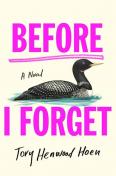

Before I Forget: A Novel
by Tory Henwood Hoen
Hardcover : 288 pages
4 clubs reading this now
0 members have read this book
A funny, heartfelt, late coming-of-age story that examines the role of memory in holding us back--and in moving us forward--for fans of The Collected Regrets ...
Introduction
"A tender, funny portrait of love in its myriad forms." --Mikki Brammer, bestselling author of The Collected Regrets of Clover
A funny, heartfelt, late coming-of-age story that examines the role of memory in holding us back--and in moving us forward--for fans of The Collected Regrets of Clover and Maame.
Call it inertia. Call it a quarter-life crisis. Whatever you call it, Cricket Campbell is stuck. Despite working at a zeitgeisty wellness company, the 26-year-old feels anything but well. Still adrift after a tragedy that upended her world a decade ago, she has entered early adulthood under the weight of a new burden: her father’s Alzheimer’s diagnosis.
When Cricket’s older sister Nina announces it is time to move Arthur from his beloved Adirondack lake house into a memory-care facility, Cricket has a better idea. In returning home to become her father’s caretaker, she hopes to repair their strained relationship and shake herself out of her perma-funk. But even deeply familiar places can hold surprises.
As Cricket settles back into the family house at Catwood Pond?a place she once loved, but hasn’t visited since she was a teenager?she discovers that her father possesses a rare gift: as he loses his grasp of the past, he is increasingly able to predict the future. Before long, Arthur cements his reputation as an unlikely oracle, but for Cricket, believing in her father’s prophecies might also mean facing the most painful parts of her history. As she begins to remember who she once was, she uncovers a vital truth: the path forward often starts by going back.
With laugh-out-loud humor and profound grace, Before I Forget explores the nuances of family, the complexities of memory, and how sometimes, the people we know the best are the ones who surprise us the most.
Editorial Review
No Editorial Review Currently AvailableExcerpt
Chapter 1 I am stuck between selves. Right now, I am no one. I am also stuck, literally, in the mud, the wheels of my janky hatchback spinning in fruitless circles as they work themselves deeper into the earth. I should have known better than to drive up this particular road in this particular car at this particular time of year, but I forgot. It has been a while since I visited my father’s house. More than a while. It has been nine years. As I rev the engine, I recall his classic refrain: “If you visit during mud season, you must really mean it.” In this area of New York—way upstate, farther than most urbanites are willing to go nowadays—there is this murky fifth season that falls between winter and spring, when everything is brown and dense, when the dirt roads turn soft and unruly as they thaw inch by stubborn inch. The other four seasons have their obvious charms, but mud season is a slog, palatable only to the locals and navigable only with the deepest of treads. My treads are inadequate, and I haven’t been a local for a long time, which is probably why my five-hour journey has reached a premature conclusion here, a mile short of the house, where the cracked asphalt yields to dirt (or in this instance, sludge). I climb out of the car and wave my phone skyward, trying to get a signal so I can ask my older sister, Nina, to come fetch me in her sturdy Subaru. But again, I should know better—this section of woods is especially dense, and there is no hope of cell service. As the sun starts to dip behind the pines, I realize I’ll have to start walking if I want to get to the house before dark. This would not normally be a problem—except my suitcase is on wheels. I squelch my way around the car, pop the hatch, and dig through the miscellany that has accumulated in the back. If wealth were measured in complimentary linen tote bags, I would be a millionaire. I spot one that bears the logo of my employer, Actualize, and our tagline: WHAT WOULD YOUR BEST SELF DO? “My best self can fuck right off,” I say and then immediately feel bad. I apologize to the limp bag. “Sorry. It’s not your fault. That was my quarter-life crisis talking.” I’m convinced I have hurt the tote’s feelings, so I grab it from the pile. Empathy is a good thing, but I might have too much of it. I transfer a few essentials from my suitcase to the bag, then close the hatch and lock the car, although there’s no need for such caution. Almost nobody comes this way. The road snakes uphill, and I take a few steps in the sucking mud before finding a smoother groove where the dirt meets the undergrowth. It occurs to me that this is the exact time of year when the black bears are emerging from their winter sleep, and while I am an animal lover, I’m not looking to encounter any large wildlife at this moment. “Hi, bears! It’s me, Cricket! Just passing through! Nothing to see here!” I call out. It’s not far to the house: just a half mile up and then another half mile down toward the water. It doesn’t take long for me to reach the crest of the hill, where I can see Catwood Pond stretching below—a ragged gash in the landscape formed by glaciers eons ago. Still partially frozen, its surface is mottled with patches of snow and inky soft spots, where water surges up from the ancient springs that feed the pond. Given its considerable size and depth, I always thought Catwood Pond deserved the designation of lake, but we don’t always get what we deserve. The pond was supposed to have been named for some guy named Gerald Gatwood, who built the first camp in this corner of the Adirondacks. Someone’s smudgy handwriting was to blame for the misrecording of the pond’s name in official records, and no one ever bothered to correct it. Catwood it was, and Catwood it would remain. Sometimes our mistakes define us—that’s just how life is. The dimness settles around me as I walk, and the familiarity of this place seeps back into my senses. I know it’s only a matter of time until I stumble upon the one memory that is too hard to bear. Instead, I think back to last week and the call from my sister. * * * “Do you have a minute? It’s about Dad…” Nina had said. I braced for bad news, certain that he was dead. “Dead? No!” Nina laughed off my panic. “Well, why would you say it like that? ‘It’s about Dad…’” “Sorry, sorry. There’s no crisis. It’s actually good news. I got offered a postdoc,” she clarified. My heart still pounding, I tried to convert my worry into excitement as she continued: “In Stockholm.” “Stockholm?” I didn’t even realize she had been applying for positions, let alone considering moving abroad. Her PhD is in computational biology, with a focus on maternal health, and she has spent the last few years studying endometriosis at the molecular level. Biomarkers, DNA sequencing, protein networks—these are the terms she uses to explain her work. I had naively assumed that she was content to analyze DNA on this side of the Atlantic, but I could hear the excitement in her voice as she said, “There’s an institute in Stockholm where I can jump right into the next phase of my research. Unlike this country, Sweden actually funds women’s health studies.” “Women’s health? I think I’ve heard of it. But surely it can’t be complex enough to merit research,” I joked. “Shocking, I know,” Nina said. “And I’ll be working with Elin Sundholm, so it doesn’t get any better than that.” I had no idea who that was, but it had been a long time since I had heard Nina this energized. I knew there was no slowing her momentum, so I turned to logistics. “Okay … so how will that work? Dad will go with you?” “I don’t think that would make sense. It would be too disruptive for him, and not ideal for me.” “Right, of course. But who will take care of him?” Nina was silent for a moment. “I’ve looked into our options. Dad’s Medicare doesn’t cover long-term care, so we’ll have to pay out of pocket. Full-time, in-home help is way too expensive, so I think our only option is to move him into a private memory-care facility.” “Oh,” I said, letting it sink in. “There are some not too far from here, near Lake George,” she continued. “They’re not cheap, but we could swing it if we sell the house. Unless you want to take over.” I assumed she was joking about the last part. I live in New York City, and I barely have the wherewithal to take care of myself, let alone a seventy-four-year-old with dementia. I am only twenty-six, which means I am essentially a larva. In contemporary America, childhood can last well into one’s thirties, forties, and even fifties. I’ve seen it happen. And besides, my father doesn’t even know who I am anymore. He hasn’t recognized me for at least three or four years—I don’t know exactly when I faded from his memory, but I know I’m gone. “Me? Move to Locust? You’re kidding, right?” “Only half kidding. Honestly, I think Dad would love it. He always liked you best.” “That’s not true.” “Yes, it is. Mom likes me more; Dad likes you more.” Nina said it as if everyone agreed on this point. It’s true that my father and I were once exceptionally close, but that seemed like a lifetime ago. She went on: “It could be good for you, too. Change of scene, change of perspective. Maybe Gemma would let you work remotely?” “Doubtful. It’s hard to bring someone their matcha remotely.” She snorted. “Fair enough.” In the silence that followed, I could almost hear her weighing her words. “Listen, Cricket. I know Catwood Pond is a complicated place for you. But there was a time when you loved it here. It was your favorite spot on earth.” “I can’t, Nina. We both know I can’t.” She didn’t push any further, and we eventually came to a mutual decision: find a long-term-care facility for our father and sell the house to pay for it. Really it was Nina’s decision—she is our family’s de facto leader—but she is skilled at including me without actually expecting anything of me. She has always known how to trick me into thinking I have agency. In that respect, she’s an exemplary older sister. * * * So that is why I’m here now, traipsing through the mud-laden woods in my flimsy canvas sneakers. This weekend, we will tour two potential homes for Dad. Nina leaves for Stockholm in two months, so we don’t have long to get organized, but she had the foresight to wait-list him a year ago, just in case, so we know he is guaranteed a spot. My sister is always a step ahead. As I round the bend toward the house, I am hit by the scent of April—mossy and metallic, comforting and melancholy, woodsmoke on the cold wind. I reach the driveway and pass the carved-wood sign that bears our last name, Campbell. The nails holding it flush to the spruce tree have rusted, and dribbling sap has stained it over the years. The undulating surface of the long dirt drive is still familiar underfoot. I avoid the deep grooves worn by tires, choosing instead to walk along the elevated ridge of matted grass between them. Before long, I emerge from the trees to see the illuminated windows of the house, unblinking, watching my advance. I sprint the final stretch like I used to as a child. Back then, it was to outrun the werewolves. Now, it’s to outpace the ghosts. Copyright © 2025 by Victoria Hoen view abbreviated excerpt only...
Discussion Questions
From the publisher - added by Pauline1. How do the flashbacks into Cricket’s past contribute to your understanding of her character in the present,
and how do they shape your reading experience?
2. Discuss the evolution of Cricket and Nina’s relationship over the course of the novel. How does Cricket’s
perspective of Nina correlate with her self-image for most of the story, and what are the effects of this?
Compare and contrast their respective caregiving approach.
3. How does Before I Forget critique our culture’s obsession with monetization and profit versus intrinsic value
and service? “[Cricket] was exhausted by the compulsion to monetize everything; to convert every glimmer
of authenticity into a product; to scale small joys until they are so bloated that they wither and droop.” (page
218) Discuss the ethical implications of using advanced technology to immortalize Arthur for financial gain,
and why you think Cricket did not want to profit from the oracle project.
4. Considering Gemma’s promotional content, how does social media contribute to generating a heightened
interest in “wellness” products and instilling a sense of urgency and necessity around them? To what
extent do you think it can be taken too far, if at all? How does society’s view on aging and beauty
standards feed into this “wellness” obsession? What do you think people are truly seeking when they
indulge in Extreme Wellness?
5. How does Gemma’s idea of self-care differ from Carl’s idea of it? What is something you turn to as a form of self-care?
6. Compare and contrast Locust and New York City. How does
Cricket’s setting influence her character development? How
do the pace and community dynamic differ in each location?
7. How is the Adirondacks house a main character within the novel, and how does it reflect broader themes of identity and change? How does the house reflect Arthur’s and Tish’s contrasting outlooks?
8. What do you make of the loons? Why do you think Cricket is so intrigued by the loonlet toward the end of the novel?
9. What does Cricket’s recurring dream, and its evolution, reveal to you about her internal state? Have you ever had a recurring dream?
10. Cricket and Arthur are both at pivotal yet opposite stages in their lives when they reunite. How do you think they
each impacted the other’s sense of self during this crucial time, if at all? In what ways do you think Cricket might
have been holding herself back, and how does Seth’s tragic accident shape Cricket’s sense of herself, and her
relationships, for a decade? Have you ever felt defined by the stories you tell yourself?
11. “Since his diagnosis, my father’s social network has atrophied. People aren’t sure how to interact with him, so
they just stop interacting at all.” (page 23) How does the fear of not knowing how to engage with a person who is
ill lead them to social isolation? What are some steps an individual could take to ensure continued support and
connection with an ailing friend or loved one?
12. Though Before I Forget addresses the challenges of caretaking and memory loss, it also considers the
opportunity to shift perspectives—in this case, Cricket appreciates Arthur’s newfound ability to connect with his
intuition without the weight of the past. How does it feel to focus more on what is gained in old age, rather than
what is lost?
13. This story explores how grief and life’s most difficult situations, while painful, can simultaneously encourage
growth and lead us back to ourselves. “Not our final selves, or even our improved selves, but just our next selves.
After all, we are always between selves. It doesn’t mean we are lost—it means we are growing.” (page 270) What
does Before I Forget suggest about the importance of tapping into your intuition? What are some ways you could
go about doing this?
14. How did this novel impact you, and what emotions did it leave you with? Did it perhaps “show you what you
already know” (page 175)? As Nina tells Cricket, “The best things are still ahead of us.” (page 18) How do you
imagine Cricket’s life beyond the page?
Book Club Recommendations
Recommended to book clubs by 0 of 0 members.
Book Club HQ to over 90,000+ book clubs and ready to welcome yours.
Get free weekly updates on top club picks, book giveaways, author events and more