




BKMT READING GUIDES
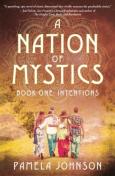

A Nation of Mystics/ Book One: Intentions
by Pamela Johnson
Paperback : 370 pages
0 club reading this now
0 members have read this book
In A Nation of Mystics, author Pamela Johnson deftly explores the youth subculture in San Francisco and Berkeley in the mid-1960s, with all its initial goodwill and naiveté--its dedication to free speech, promise to end war, commitment to racial equality, new art and music, and the ...
Introduction
In A Nation of Mystics, author Pamela Johnson deftly explores the youth subculture in San Francisco and Berkeley in the mid-1960s, with all its initial goodwill and naiveté--its dedication to free speech, promise to end war, commitment to racial equality, new art and music, and the exploration of spirituality based on mind-expanding hallucinogens.
In this epic story of intimacy, metaphysical exploration, and coming of age, the Haight-Ashbury becomes home to genuine and unforgettable characters: Christian Brooks, haunted by a fiery riot in India, leaves the ministry for a new path to God. Kathleen Murray arrives seeking to change the world and exchanges picket lines for a more direct method of altering consciousness. Brilliant young botany student Myles Corbet must choose between prison and betraying his oldest friend. Jerry Putnam, seeking knowledge through science, instead discovers the shamanic calling. Opposing them is drug agent Dolph Bremer, who vows to crush the counterculture movement through any means necessary, while attorney Lance Bormann carefully walks between worlds to defend his young clients.
Book One, Intentions, is the story of the communal family's growing commitment to the creation of a new culture--to social action, expanded awareness, new insights into the nature of mind, and the courage to make change.
Although set in the 1960s, A Nation of Mystics is strikingly relevant, addressing conflicts between political idealism and the old order, violent police overreach, and the beginning of America's War on Drugs.
Excerpt
Chapter 1 Christian Brooks University of California, Berkeley October 1965 With his scream still receding into the shadows of the room, Christian Brooks struggled to wake among a tangle of sheets, pushing against the nightmare of burning buildings and the grasp of dark hands. He blinked and looked around. No longer were there angry shouts, the sound of explosions, the roar of fire. The only sound was the harsh rasp of his breathing. He was safe, he slowly realized, no longer in danger, but safe here in the Berkeley apartment. Rising in the dim light of dawn, he stumbled through hazy shadow and leaned his forehead against the cool glass of the windowpane. The pale, pink, October sky was growing brighter, colors changing by the second. Still breathing heavily, Christian ran his hands across his face and eyes and looked to the street below, to movement, color, someone walking in early morning—anything to distract his fast-beating heart. Behind him, the bedroom door opened slowly, hesitatingly. “Hey, man,” Matt’s sleepy voice mumbled. “Everything okay?” “Just . . . just a bad dream,” he murmured, embarrassed he was unable to control the trembling in his voice. “You want to talk about it? It’s not the first time.” He stood naked at the window, his back turned to Matt, but Christian still saw images in bits and pieces, a night of riot in the Punjabi city of Amritsar, narrow streets filled with madness and terror. In the confusion of the dream, he was forever running after Nareesh . . . so close, Nareesh was so close . . . but no matter how fast he ran, Christian was never able to reach him, was only able to chase his friend’s vanishing form, muted on one side by shadow and illuminated on the other by the glare of fire. Instinctively, he rubbed the thin, raised scar near his left temple, a small but terrible reminder of what had happened in India only months ago. In this moment of absolute truth, this place where he could not hide from himself, he finally asked the question he had tried to avoid: Was it his fault? view abbreviated excerpt only...
Discussion Questions
1. In A Nation of Mystics, author Pamela Johnson suggests that political events begin the formation of a new counter culture. What are some of the signs that a counter culture is beginning? Discuss the elements of the majority culture that the youth revolution believes must be changed? Are they right to think so?2. How do the youth of the story see the war in Vietnam as a major event shaping the lives of Americans and Vietnamese? Why do they believe war must end? Given the privilege of their lives, why would they care?
3. How does the American Civil Rights Movement help to define youth politics in the mid to late Sixties? What are some of the risks in participating in social change?
4. Why are the characters of the story alienated from their parents? Is there something the young adults could do differently to be themselves and keep family generations whole?
5. The late Fifties and Sixties see the beginnings of changes in attitudes toward sexual behavior. Although sexual attractions and liaisons throughout the ages have remained the same, the prevailing attitude of the Sixties is that these sexual relationships can be openly expressed. How do the characters respond to open sexuality? Are their attitudes a product of fantasy or practicality?
6. Define the role of many of the women or “old ladies” of the hippie movement as portrayed in the story. How are the different from traditional society?
7. The characters of the Haight-Ashbury, Laguna Beach, and Berkeley use drugs as “sacraments”. What is there to the experiences in the story that might suggest a sacramental or mystical experience? Can a mystical experience be achieved through the use of psychedelics?
8. Music is a major factor in the story. How does the music of the period reinforce prevailing political and social ideas? How do the messages of the music achieve the task of uniting millions into a counter culture?
9. Within the business worlds of the underground, no longer expected to be housewives, women are beginning to take a larger role. How do some of the female characters show the beginnings of the women’s liberation movement?
Notes From the Author to the Bookclub
“A sprawling, epic novel of classic dimensions that vividly recreates the psychedelic sixties – the hopes, the fears, the naiveté, the knowing that was at the heart of those turbulent times.” – Joel Selvin, culture and music columnist, San Francisco Chronicle; author, The Haight: Love, Rock, and Revolution “In her exciting novel, Pamela Johnson has crafted a work of literature that conveys big-picture ideas through the most intimate of characters. A Nation of Mystics sings with the sense of wonder and awe that inspired a generation to change the world—one atom and synapse at a time.” – Nicholas Schou, author, Orange Sunshine: The Brotherhood of Eternal Love and Its Quest to Spread Peace, Love, and Acid to the World “The deeply insightful and knowledgeable presentations of spiritual practices in both Eastern and Western traditions and the grueling rigors of cleansing and renewal to attain the blessings of sacred plants, are dramatically documented. These quests are captivating. I would rank Pamela Johnson among the best of modern storytellers. She has the rare ability to combine valuable history lessons with highly entertaining portraits.” – Jim Ketchem, MD, author of Chemical Warfare: Secrets Almost Forgotten: A Personal Story of Medical Testing of Army Volunteers “I was particularly moved by the story because Pamela captured the feel of the Brotherhood of Eternal Love. The book explores many of the facets of the scene, including LSD manufacturing and hash smuggling, from 1965–1970, both the sweet and the bitter, in a way that is very hard to accomplish in nonfiction.” – Tim Scully, underground chemist, Orange Sunshine and subject of the documentary The Sunshine Makers (2015) “In her trilogy A Nation of Mystics, Pamela Johnson, with a remarkable eye for historical detail, masterfully charts the beginning, middle and end of this era.” – Peter Maguire, author of Thai Stick: Surfers, Scammers and the Untold History of the Marijuana Trade “Many thanks for giving me the privilege of reading this book…I never thought to see our original hope about such things be presented so openly because of the continued political backlash…A Nation of Mystics renewed my faith in our original dream of raising consciousness.” – Jean Millay, filmmaker, co-creator of The Psychedelic Experience, with Timothy Leary and Richard Alpert; and author, Multidimentional Mind: Remote Viewing in HyperspaceBook Club Recommendations
Recommended to book clubs by 0 of 0 members.
Book Club HQ to over 90,000+ book clubs and ready to welcome yours.
Get free weekly updates on top club picks, book giveaways, author events and more