




BKMT READING GUIDES
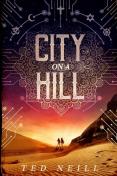

City on a Hill
by Ted Neill
Paperback : 400 pages
0 club reading this now
0 members have read this book
Introduction
Faith, religion, godliness—these things have caused more pain, suffering, and death than all the plagues of history combined. In Fortinbras, a city built in the aftermath of a religious war that nearly ended all life on the planet, religion is considered a disease. The residents are taught that they are all that is left of humanity and the cold law of logic and reason rule their lives. Sabrina Sabryia, a young police cadet, is a resolute enforcer of the law until her loyalties are torn between her best friend Lindsey Mehdina, a charismatic spiritual leader, and her uncle Angelo D’Agosta, the head administrator of the city.
The conflict drives Sabrina and Lindsey across a radioactive wasteland pursued by cyborg bounty hunters. They quickly learn that what they took for truth in Fortinbras was not all that it seemed. Meanwhile terrorists plot a religious uprising that threatens millions of innocent lives and Sabrina and Lindsey must choose sides. Their choice pits friendship against family, war against peace, and eventually, faith against doubt.
Excerpt
Chapter 1 Lindsey Mehdina “Lindsey has beetles crawling on her!” Sylvia squealed to her friends. The four girls stood in a semicircle, cutting Lindsey off from the view of the teachers who gossiped on the far side of the playground in the shade of the school building. The building had taken on the drab colors of the playground, covered in the same dust that rose from the parched ground to settle on the goal posts, swing sets, and climbing bars—and by the end of recess—most of the children. Lindsey had put herself in this vulnerable position, choosing a distant part of the schoolyard to draw in the sand undisturbed. So isolated that she was too tempting a target for Sylvia and her gang. The nearest children were the five-year-olds—too young to help—swinging on the climbing bars. The older boys, who often liked the portraits Lindsey would draw for them, were far too engrossed in their pitchball game to notice what was unfolding. Lindsey placed her hand over her breast pocket where she had hidden the beetles, one tumbling over the other like little gem stones. She remembered saying, “Don’t hurt them,” just before the seizure took her and the vision flickered before her eyes. Once, after watching her across the breakfast table, her brother Sam told her that when she seized, her eyes tipped back in their sockets and rolled around like marbles. Her limbs shook, and sometimes snot came out of her nose. Sometimes she bit her tongue, and her teeth turned red from blood. It seemed an undignified state to her and at impossible odds with the revelations she saw with her inner eye: people, people she knew, people she had yet to know but would know. Sometimes she saw people when they were younger, often when they were older. Sometimes she saw landscapes: shady forests, heaving seas, tranquil rivers. She saw crescent moon dunes crossing deserts one grain of sand at a time. Suspended on threads of wind, she knew each grain, its golden, amber, or rose brilliance. A canyon. A cave. A thousand candles shining though glass. Then she would come to with her cereal bowl turned over, milk on her lap, her brother resting his chin in his hand as he stared at his stopwatch. “Forty-seven seconds,” Sam said. “It felt like eternity.” Lindsey was not sure how long this seizure and its vision had lasted. She never knew how long the visions were. She lost all sense of time. But Sylvia was staring down at her with her three friends, the sounds and shouts of other playing children continued uninterrupted, so she knew she was still at recess. No teachers’ faces floated above her, so she could not have been on her back long enough to attract much attention. Lindsey tried to prop herself on her elbow, but her muscles were still not responding. She flopped back down, hitting her head. The other girls snorted and laughed. Lindsey had braided her locks so carefully that morning, tying them with fluorescent elastics to tame the wiry curls. Now they had escaped from their bands. One stood on end waving before her face, the sun winking behind it. Her head felt as if there was a vice clamped around it. She could taste blood in her mouth and feel mucus sticking in the back of her throat. Sylvia ground one of the loose elastics into the ground. “Your teeth will fall out, and you will be ugly the rest of your life,” Lindsey said through panting breaths. The laughing stopped. “What did you say, you little spaz?” Sylvia said, her lip curling. Lindsey swore inwardly. This also happened after an episode: she said thoughts out loud. Her brother always found it amusing, but it was far from funny now. Sylvia leaned in close to her, grabbed a fistful of hair, and pulled. Lindsey cried out but was unable to defend herself. She used what control she had regained in her arms to protect the beetles in her pocket. Sylvia was so close that Lindsey could feel her spit on her face. Those gray eyes, thin lips, and freckles were unmistakable. Lindsey had just seen them in her vision. The whole of it came back then. She had been sitting on a tuft of grass, drawing in the dust with a branch. Sylvia had come over, dragging the soles of her shoes, scraping away the stars, the moons, the birds, and the butterflies Lindsey had worked so hard to render. Closer, Sylvia had spotted the beetles and cried out. Then the vision came. It was not unusual for Lindsey to experience visions of a person standing right before her. So it did not surprise her that a piece of Sylvia’s future seemed to have detached itself from the bowl of sky and fallen on her. She had seen Sylvia, her freckles faded with age, her fiery hair turned to a more subdued auburn. She was not actually ugly. Her face was lean and had lost the softness of baby fat, but she was comely in an elegant sort of way. Grown Sylvia opened her mouth to call three children—Sylvia’s own children, Lindsey guessed—and where one of her front teeth should have been there was a gap. Young Sylvia shook Lindsey back into the moment. “Did you call me ugly?” “Ugly. So ugly. Your teeth will fall out,” Lindsey muttered as if drunk. If her brother had been there, he would have been laughing. Pain spread like fire across her scalp as Sylvia pulled harder. “Let her go.” A fifth figure had quietly walked up beside them without anyone noticing. It was the new girl, Sabrina Sabryia. She was lean and gangly, her hair always pulled back into a utilitarian pony tail, and her thick brows always furrowed into a scowl. She wore what she wore every day: a black, long-sleeved shirt and black trousers tucked into oversized boots. Her unchanging wardrobe would have made her the object of ridicule had she not arrived each day in a black ministry roll pod, long and spacious, with tinted windows, unlike the civilian roller pods (CRPs) that the other parents drove. Girls would not play with her because she looked like a boy, and boys would not play with her because she was a girl. Lindsey, recognizing a fellow outcast, had tried talking to her once. “Your name is Annaliese,” she had said. “No, it’s not. I’m Sabrina Sabryia.” “Are you sure? I saw someone call you that in a dream.” “Are you a little crazy?” “I guess so.” Now Sabrina was studying the other girls, her eyes scanning back and forth, the muscles in her jaw working as if she was trying to crack a nut in her molars. The fabric on the elbows of her long sleeve was threadbare, as if worn from her crawling in small spaces or up trees. Her boots were scuffed and dirty, but the laces were tied with perfect, balanced precision. The other girls, in their pressed pastel dresses and plastic barrettes, could have been specimens of a different species. They crossed their arms and jutted their chins in a show of feminine solidarity. Sabrina did not notice. Arms akimbo, standing as a teacher might, she stared at Sylvia, a little dumbfounded that the girl had not obeyed her command. Yet the pressure on Lindsey’s scalp lessened, and she let out a small cry of relief. “Why should I let her go?” Sylvia insisted. “You should mind your own business.” “What did she do to you?” Sabrina asked. “She called me ugly.” “Did you?” Sabrina asked, turning to Lindsey. Lindsey nodded and withered inside when she read the disapproval on Sabrina’s face. But it was fleeting. Sabrina’s eyes shifted to the ground. The new girl was silent a long while, turning her head, her body, even moving her feet delicately as she discovered the drawings below. Then she did something Lindsey did not expect. Sabrina smiled. Her smile lacked any self-consciousness, yet it looked out of place on a face that was always scowling. It floated there like an unexpected guest, lingering as Sabrina examined the work, even the images Sylvia had scuffed, as if she was trying to puzzle out what they had been before they had been destroyed. When Sabrina had completed a circuit around Lindsey, she turned to the other girls and spoke in a flat, soft, voice. “Sylvia, if you touch her again, I’ll punch you in the face.” The three other girls wore identical expressions of horror as they began to inch in the direction of the teachers. Sylvia stiffened, made to step back but then pirouetted on her foot, grabbed Lindsey’s hand and crushed her fingers together. Lindsey tried to relax her grip, but it was too late. The beetles’ shells cracked, and warm goo spread out of her breast pocket. Sylvia’s laugh only lasted a moment before it was cut off. Sand ground beneath the sole of Sabrina’s shoe as she shifted her weight. That sound was followed by a hard, wet smack. The other girls were running now, screaming. Sylvia dropped to her knees beside Lindsey, holding her mouth, her two front teeth knocked askew and pink with blood. At the sight of red on her fingers, Sylvia’s face grew pale. One tooth became completely detached and rolled across Sylvia’s lip into her palm, where it rested like a gleaming stone. She turned to follow her friends, her shoulders beginning to shake with sobs. “Ow,” Sabrina said, rubbing her knuckles before she become aware of Lindsey staring at her, at which point she shook her hand out at her side. The boys playing pitchball on one of the more distant fields caught her attention for a moment before she turned back to the drawings at her feet. “I can draw more if you like, Annaliese.” “I told you, my name is Sabrina,” she said as she leaned over more drawings: a spiral, a moon, a fox. The fox Lindsey had drawn with dimensions and depth, but it had not turned out quite as well as she had liked. Lindsey burned with shame. Sylvia had obliterated a much better attempt of a hare. She wished Sabrina had seen that one. The teachers were coming over now, crossing the field in long strides, their arms swinging straight and fast at their sides. “I warned her.” Sabrina said with sincere wonder as she watched the teachers approach. “I warned her. Why would she do that?” “It’s all right,” Lindsey said wiping the sticky, gleaming shells from her fingers onto her trousers. “We’re going to be friends until the day we die.” “How do you know?” A teacher arrived and yanked Sabrina’s arm so hard that her feet lifted off the ground. “I’m just often right about these things,” Lindsey said as they dragged Sabrina away. view abbreviated excerpt only...
Discussion Questions
1. In chapter nineteen Lindsey and Sabrina have a discussion regarding the nature of religion and spirituality, which Lindsey taking the position that it is “needed” to cope with the human condition, while Sabrina claims it is more of a delusion, a lie people tell themselves. Is there a perspective that resonates with you? Is there one perspective you think the author is endorsing over the other?2. Is there a "right" answer on whether religion plays a positive or negative role in society? Why or why not?
3. Some readers and reviewers have posed the (unanswered) question of whether or not Lindsey and Sabrina’s relationship was more that platonic. Would a romantic reading of their relationship change your view of their story, of their characters? Do you believe there is evidence proving either interpretation unequivocally?
4. Frequently, the book points out secular sources that society draws upon for meaning, e.g. sports, fashion, science. Can these things sufficiently “substitute” for spirituality?
5. Do you consider Lindsey’s character a terrorist?
6. The conflict between Israel and Palestine is often cast as one of intractable, timeless religious conflict, however, the opposite is actually true. Until the twentieth century Jewish and Palestinian communities lived side by side, in peace for centuries. Historians and commentators have pointed out that it was only during the British partitioning of land for a Jewish state and the exile of Palestinians that the conflict took on religious overtones. What should be a conflict over land—which are resolved frequently through secular means—turned into a “intractable, timeless,” religious conflict, a clash of “civilizations” that might only be resolved through the elevation of one arbitrary supernatural being over another. How does City on a Hill contribute to one narrative over another? Is it a helpful or harmful contribution?
7. What do you think of the morality of Sabrina’s choice at the end of the novel?
Book Club Recommendations
Recommended to book clubs by 0 of 0 members.
Book Club HQ to over 90,000+ book clubs and ready to welcome yours.
Get free weekly updates on top club picks, book giveaways, author events and more